


A lot of teams switched to a cheaper model this year. The AI bill went up anyway. Nobody lied on the pricing page. The unit of spend just moved from “which model” to “how many calls,” and most budgets didn’t move with it. That gap is exactly what AI FinOps exists to close.
Cheaper tokens, bigger bills
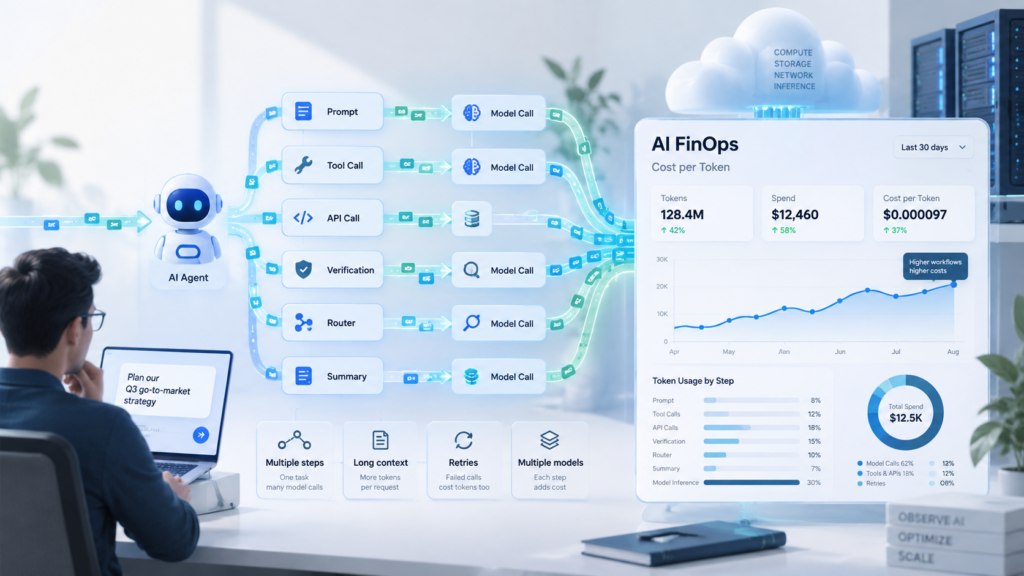
A chatbot reply used to be simple. One prompt, one response, one line item. Agentic workflows don’t work like that. An agent that researches a topic, queries a database, calls an API and drafts a summary makes a long chain of model calls to finish a single task. Add a reviewer agent, a router picking between models, and a conversation history that gets re-sent every call, and one “task” starts eating tokens like a small batch job.
A lower price per token doesn’t touch that multiplier. A cheaper model that gets called far more often per workflow is a net loss. Most teams find out when the invoice lands, which is the worst possible time to find out anything.
The analysts have a name for it
Gartner calls this the Inference Paradox. Tokens are getting cheaper, but not as fast as AI capabilities and their associated costs are rising, so better unit economics end up pushing the overall cost of AI higher. Their forecast has inference cost per agentic workflow climbing steeply over the next few years. Not because calls got pricier. Because there are so many more of them. Gartner
IDC points at the other half of the problem. Its research on AI cost governance found that difficulty budgeting for token- and inference-based pricing is now the biggest barrier IT leaders report when evaluating AI vendor pricing. IDC argues that agent cost overruns are a governance failure rather than a budgeting error, since engineering can see problems in real time but can’t act on them, while finance holds the authority but sees the bill weeks late. Everyone can see a piece of the fire. Nobody’s holding the extinguisher. IDCIDC
Cost per token isn’t a footnote in a model comparison chart anymore. It’s an infrastructure metric.
We’ve seen this movie. It was called cloud.
Early cloud adoption went the same way. Teams spun up resources freely because the sticker price per instance looked reasonable. Nobody watched usage patterns. Then finance opened a bill that matched nobody’s mental model. FinOps grew out of that mess, and the FinOps Foundation now applies the same framework to AI spend.
The difference is speed. A cloud bill mostly grows in step with usage. Token spend compounds. One workflow change, like an extra tool call, a longer context window or a second model double-checking the first, multiplies the cost of every run that follows. Cloud was a leaky tap. Agents are a leaky tap that installs more taps.
Where the tokens actually go
The same patterns show up in almost every surprised team:
- Context that never gets trimmed. The agent re-sends the full conversation history on every call instead of summarizing it. Cost grows with every turn, not just with the task.
- Routers nobody counted. A cheap model handles routing and an expensive one does the real work. Then it turns out the cheap one gets called constantly.
- Retry loops. A failed API call or malformed response triggers another model call to fix it. That correction loop quietly stacks up tokens on a single step.
- Agents grading their own homework. A second model checks the first one’s output. Great for quality. Expensive at scale, and easy to leave running long after anyone remembers why it was added.
None of these are bad decisions. They just have a price, and the price stays invisible until someone adds it up.
How to run AI FinOps without killing the roadmap
Same order as cloud: instrument first, optimize second.
- Track tokens per workflow, not per model. That’s how the expensive agent chains show up, along with the reason they’re expensive.
- Set a budget per task type. Treat it like a budget per cloud service, and alert when a workflow drifts outside it.
- Cache aggressively. Reused context and repeated tool results shouldn’t be paid for twice.
- Price every new step at real volume. Before adding another verification pass or another model to the chain, cost it at production traffic, not demo traffic.
- Name an owner. Somebody needs both the visibility and the authority to act on it. Otherwise the dashboard is just a very accurate record of money leaving.
The model card isn’t the bill
The model still matters. But for agentic systems, workflow design sets the bill far more than the model card does. Track cost per token the way cost per cloud instance already gets tracked, and the invoice stops being a plot twist.
If your agents are already live and nobody can say what a single task costs, that’s worth fixing before it scales. Klizo builds production-grade AI and multi-agent systems and scalable cloud architecture with cost visibility designed in from the start. Happy to take a look at yours.


