


By the time a recruiter notices that international roles take longer to fill and convert at a lower rate, the problem has usually been running for months. The stalled pipeline, the strong resume that goes quiet after the first call, the offer that never gets extended because “communication” felt weak: these are late signals, not early ones. The interview itself was deciding who got a fair shot long before anyone noticed the pattern. Most hiring stacks just haven’t had a practical way to fix it.
Language bias builds into the funnel quietly
It rarely arrives as one obvious decision. A recruiting team expands into a new market, keeps its existing interview process, and assumes a good candidate will come through in whatever language the interviewer speaks. Candidates who think fastest in that language do come through. Equally qualified candidates who don’t quietly stop making it past the interview stage, and nobody labels it a language problem because it never gets recorded as one.
A few signals tend to show up before anyone calls it that:
- Interview-to-offer conversion consistently lower in one market than others
- Strong resumes followed by unusually short interview transcripts
- The same one or two bilingual staff pulled into every interview outside the core language
- Feedback notes mentioning communication more often than the skill actually being tested
- A rejection reason that says “culture fit” or “communication” with nothing more specific attached
None of these, on their own, proves a language problem. The value in these signals is that they’re worth a second look, not that they’re conclusive by themselves.
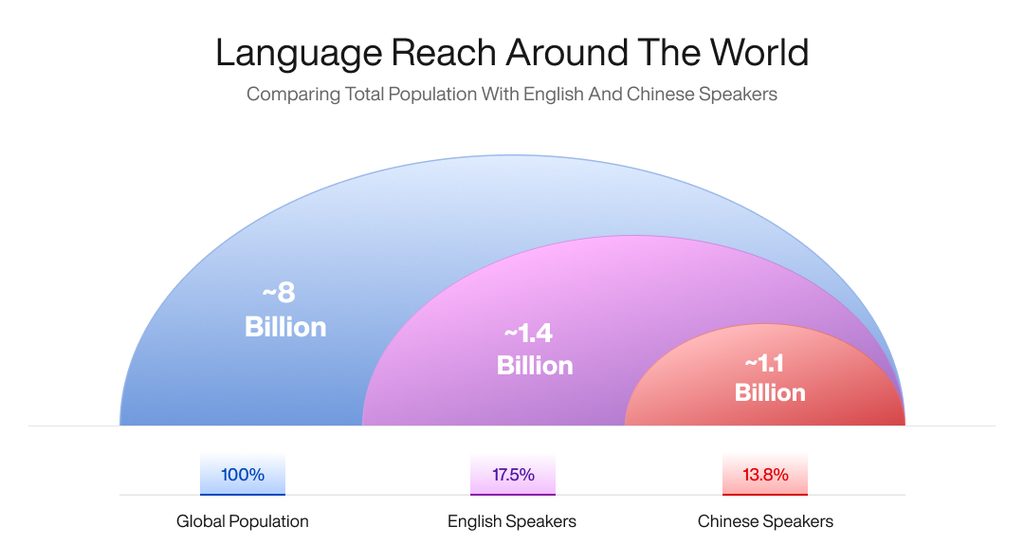
The scale of who’s affected is easier to see in the numbers. Of the roughly 8 billion people on the planet, only about 1.4 billion speak English as a first or second language, against Chinese’s 1.1 billion, according to Ethnologue’s language data. That’s under a fifth of the global workforce a single-language interview process can evaluate on equal footing to begin with.
Why recruiters struggle to see it
Recruiters mostly work from what a single interview produces: a transcript, a gut impression, a scorecard filled in by whoever happened to run that call. That’s usually enough to compare two candidates who interviewed in the same language. It’s rarely enough to compare a candidate who did and one who didn’t.
The gap widens with scale. A company hiring for one role in one market can absorb the cost of finding a bilingual interviewer once. A company hiring across five or six languages at once doesn’t get that luxury, and ends up either narrowing which markets it really competes in or leaning on the same two or three multilingual staff for every interview outside English.
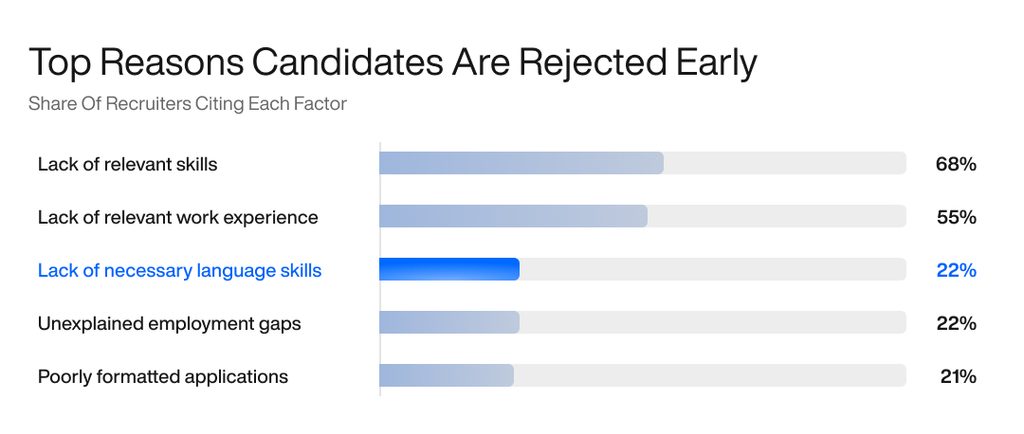
The rejection data backs this up. In IrishJobs’ 2026 Recruiter & Jobseeker Survey of 553 recruiters, lacking necessary language skills was cited as a factor in 22% of early-stage rejections, on par with unexplained employment gaps and just behind lack of relevant experience.
Why translation layers and generic ATS tools aren’t enough
Most tools that claim multi-language support solve a narrower problem than the one recruiters actually have. A resume parser that reads five languages can queue up candidates, but it can’t run their interview. A translation plugin bolted onto an English-first video call can convert words, but it doesn’t stop an interviewer from applying a different bar to a translated answer than to a native one.
Raw language coverage without a shared evaluation standard is easy to mistake for fairness. Two candidates interviewed in two different languages, by two different interviewers, with two different follow-up styles, aren’t really being compared. They’re being guessed at separately.
How AI changes the picture
This is where AI-run, multi-language interviewing earns its place. Instead of asking a recruiting team to source a bilingual interviewer for every market it hires in, AI can conduct the interview itself, in the candidate’s language, and score it against the same rubric used everywhere else.
A few examples of what that looks like in practice:
- Language-native interviewing – a candidate answers in the language they think fastest in, instead of translating in their head first
- Consistent scoring – every candidate in a pipeline is measured against the same job criteria regardless of which language the interview ran in
- Real-time adaptive follow-ups – the interview responds to what a candidate actually says instead of running a fixed script that doesn’t translate well
- One evaluation system – a hiring manager reviewing a global shortlist isn’t cross-referencing scores that came from different processes
It’s worth being clear about what this doesn’t fix. A role that genuinely requires fluent English still requires it, and no interview format replaces a real plan for language support during onboarding. What it fixes is the interview measuring the job instead of measuring English fluency by accident.
From English-first interviewing to multi-language hiring intelligence
This is the gap platforms like Interview Screener are built to close.
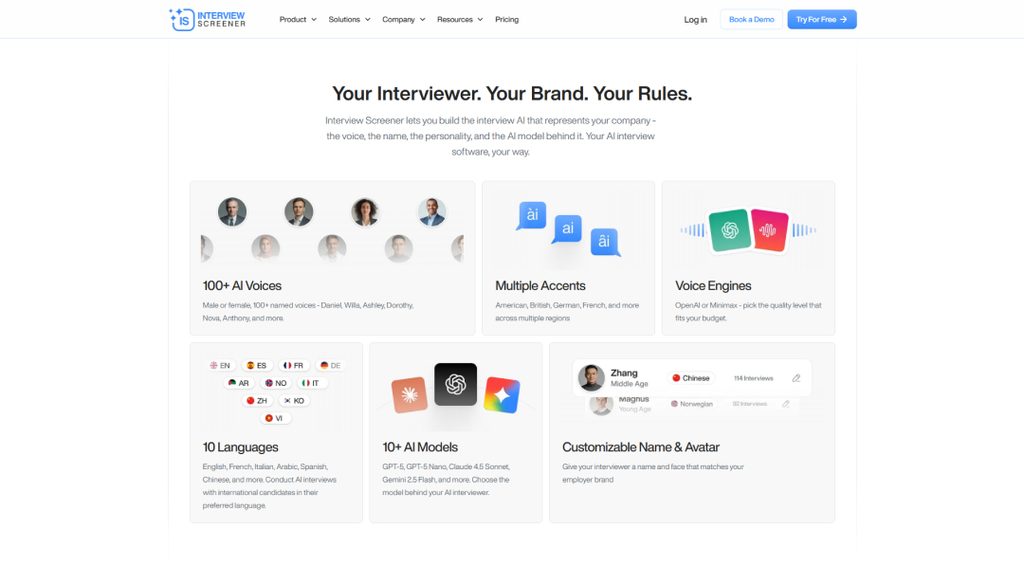
Interview Screener runs the interview and the evaluation inside one system, rather than bolting a translation layer onto an English-first tool. Its AI Interviewer conducts the interview itself, currently in ten languages (English, Norwegian, Arabic, Spanish, Chinese, German, French, Italian, Korean, and Vietnamese) with more than 100 distinct AI voices from OpenAI, and MiniMax, and adapts its follow-up questions in real time to what a candidate actually says instead of working through a fixed script. Every answer, in every language, is scored against the same four criteria – education fit, skills match, experience relevance, and overall potential — inside a built-in ATS with its own pipeline stages, status tracking, and candidate filtering, so a global shortlist lives on one dashboard instead of several.
None of this replaces a genuine language requirement for roles that actually need fluent English, and Interview Screener doesn’t claim it does. What it does is stop candidates from being screened out for a language reason that has nothing to do with the job, so a hiring manager comparing a candidate in Manila to one in Munich is actually comparing skill.
A consistent score isn’t the same as a hiring decision
None of this works if a language-neutral score replaces a hiring manager’s judgment instead of feeding it.
If a candidate comes back with a strong score from an interview run in Vietnamese, the right response isn’t to extend an offer on the transcript alone. It’s to ask the questions a scorecard can’t answer by itself. Does this role actually require English fluency, or was that assumption never tested in the first place? If it does, is there a language ramp built into onboarding? Would a short follow-up conversation, in a shared language, add anything the interview didn’t already capture?
Those are questions only a hiring manager can answer. Multi-language AI interviewing is useful because it gets more qualified candidates to that conversation, not because it replaces having it.
Where multi-language hiring is heading
The direction global hiring is heading isn’t toward every company building an in-house team of bilingual interviewers for each market it hires in. It’s toward an evaluation process that doesn’t require a human interviewer to personally speak every language a company hires in, so the language a candidate happens to think in stops deciding whether they get a fair shot.
Platforms like Interview Screener show what that shift looks like in practice: an interview and scoring process that used to need a different interpreter or interviewer for every market, turned into one system a hiring manager can run consistently, ideally before a strong candidate gets screened out for a reason that had nothing to do with the job.
Interview Screener turns a fragmented, English-first interview process into one AI-powered system that evaluates every candidate on the same terms, in their own language, from Norwegian to Vietnamese. If your team is still routing non-English candidates through interpreters or quietly avoiding certain markets, try Interview Screener free (no credit card required), or get in touch to see it run on one of your own open roles.