


The Myth of the Perfect PDF
As a Senior Talent Acquisition Specialist who has spent years at the intersection of human capital and emerging technology, I have lived through the evolution of “screening fatigue.” We have all encountered the “Paper Tiger”, that candidate whose resume is a masterclass in professional storytelling. They appear to be a 99% match on your Applicant Tracking System (ATS), boasting a meticulously formatted PDF filled with prestigious institutions and blue-chip experience.
Yet, we’ve all felt that sinking feeling when, within the first five minutes of an initial screening call, the individual behind the document bears little resemblance to the persona described on the page. In an era of AI-generated CVs and professional writing services, the gap between “claimed” expertise and “demonstrated” capability has never been wider. Resumes are static, two-dimensional artifacts that create a massive operational bottleneck for HR teams. To find the person behind the paper, we must move the recruitment process from static reading to dynamic interaction. Interview Screener is the bridge that allows us to solve this “perfect candidate” paradox.
The High Cost of Traditional Screening
Manual resume parsing is more than just a chore; it is a significant drain on company resources. James Lee, an HR Manager at Finova, recently noted that automating this initial layer saved his team 40 hours a month. Beyond the financial impact, the psychological toll of screening fatigue often leads to the very thing we try to avoid: biased, rushed decision-making.
The shortcomings of a resume-centric approach are defined by four specific limitations:
- Absence of Real-Time Assessment: A resume is a historical document, not a performance indicator. It cannot demonstrate how a candidate synthesizes information on the fly or handles the pressure of an unexpected technical question.
- Static Information vs. Dynamic Skillsets: Recruiters have no immediate way to verify the depth of a listed skill, such as “Advanced Python,” without a mechanism for intelligent, immediate follow-up.
- Keyword Optimization Over Truth: Candidates have become experts at “gaming” traditional ATS algorithms. By stuffing resumes with the right buzzwords, they bypass filters without possessing the actual competencies required for the role.
- Opaque Communication and Cultural Nuance: A well-crafted document provides no insight into a candidate’s ability to articulate complex ideas, their professional presence, or their ability to collaborate in a global, multilingual environment.
Step 1: Smarter Initial Screening with Interview Screener
The first layer of a modern recruitment workflow must treat the resume as a starting point, not the final word. Interview Screener utilizes an 8-task AI analysis, including CV and Job Description parsing, question generation, and compatibility analysis, to move beyond simple keyword matching.
This process generates a “multidimensional ATS Score” based on four critical pillars:
- Education Fit: Assessing the rigor and relevance of academic backgrounds against role demands.
- Skills Match: Determining if professional history actually supports the listed skills.
- Experience Relevance: Analyzing whether previous responsibilities translate to the current opening.
- Overall Potential: A holistic evaluation of the candidate’s professional trajectory.
What sets this apart for the HR Technologist is the distinction between the Initial Job Fit Score and the Revised Job Fit Score. The revised score reflects the AI’s reasoning after analyzing the context of the entire career path. This ensures your shortlist is populated by truly qualified individuals rather than just those who knew which keywords to use. Furthermore, deployment is seamless; David Müller, CTO at NordTech, highlighted the WordPress careers plugin for its sub-one-hour deployment time.
Step 2: The End of One-Way Prompts – Adaptive Voice Interviews
The most critical transition in the modern hiring stack is moving from “reading about” a candidate to “hearing from” them. Interview Screener’s AI Voice Interviews function as a two-way conversation, indistinguishable from a human interaction.
Powered by GPT-5.4, Claude 4.6 Sonnet, and Gemini 3.0 Flash, and utilizing voice engines from OpenAI, and Minimax, the system offers over 100 voice options with customizable accents and personas to fit your brand. The evaluation is built on three pillars:
- Real-Time Adaptation: Unlike static recordings, these AI interviewers listen. Software engineer Daniel Okafor observed that the AI asks follow-up questions that are “spot on and relevant,” probing for specific metrics if a candidate is vague.
- Communication & Fluency: The AI assesses professional presence across 10 languages: English, Norwegian, Arabic, Spanish, Chinese, German, French, Italian, Korean, and Vietnamese. This is vital for global roles where cultural nuance matters.
- Knowledge Verification: This is the “proof of work” phase. By requiring candidates to solve problems or explain processes verbally, the AI verifies that claimed skills are present, identifying “Paper Tigers” before they reach your calendar.
Importantly, candidates enjoy the process. Emma Johansson, a Product Designer, appreciated the flexibility of interviewing at 11 PM from her couch, while QA Engineer Yuki Tanaka praised the AI’s “patience and clarity” with non-native speakers, creating a more respectful environment than a rushed human recruiter might provide.
Step 3: From Guesswork to Data-Rich Shortlists
In the “Review & Hire” phase, recruiters receive a ranked shortlist with a 92.3% accuracy rate. Every candidate profile includes:
- Detailed Evaluations: Summaries of the AI’s conversation.
- Strengths and Gaps Analysis: A clear-eyed assessment of where the candidate excels or falls short.
- Technical Matching Points: A breakdown of how demonstrated knowledge aligns with core requirements.
This data facilitates objective team collaboration. With built-in commenting and visual pipeline management, stakeholders can see exactly why a candidate was ranked highly, removing the “gut feeling” subjectivity that often leads to bad hires.
The Business Case: ROI and Bias-Free Efficiency
The financial benefits of moving to AI-driven screening are undeniable. For a Senior TA Specialist whose time is valued at $50/hr, the savings are transformative.
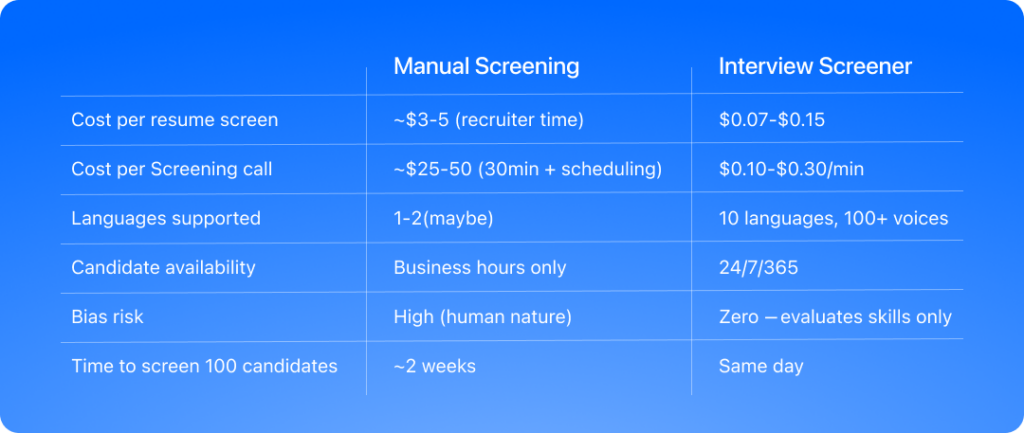
Beyond the ROI, the platform provides a Bias-Free assessment. The AI evaluates candidates purely on qualifications and skills, ignoring names, age, gender, or appearance. Ensuring a standardized and fair experience for every applicant.
Conclusion: Reclaiming the Human Element of HR
The transition from “reading” a candidate to “hearing” them represents the future of holistic hiring. By utilizing multidimensional screening, we can reclaim our time and reserve our energy for the “best of the best.”
Interview Screener allows us to move beyond the paper trail and identify the true talent within the applicant pool. It is time to stop being misled by the “Paper Tiger” and start building teams based on verified capability and potential.