


Why Building an MVP in 2026 Is a Completely Different Game
The concept of a Minimum Viable Product is not new. Eric Ries popularized it over a decade ago, and since then, every startup accelerator and venture capital firm has preached the gospel of building small, testing fast, and iterating based on real user feedback.
The philosophy has not changed. How MVPs are built has changed completely.
In 2026, artificial intelligence is not a feature you bolt onto your product after launch. It is the engine that drives the entire development process from the first line of code to the final deployment. AI-assisted development has compressed timelines that once stretched across six months into sprints that last weeks. It has reduced costs that once demanded six-figure budgets into investments that startups can manage with seed funding.
According to McKinsey, AI adoption in product development has led to a 30 percent reduction in time-to-market for startups. Teams using AI copilots report 30 to 60 percent faster task completion in coding tasks. The CB Insights startup tracker shows that founders who ship MVPs within 60 days have significantly higher fundraising success.
At Klizo Solutions, we have been building web applications, mobile apps, and SaaS platforms for startups and enterprises for years. Our founder launched multiple startups and invested in early-stage companies. We have built the intellectual property for companies that have raised Series A rounds.
This article is a comprehensive, step-by-step guide to building an MVP in 2026 using AI-assisted development. Whether you are a first-time founder, a product manager exploring a new vertical, or a technical leader evaluating modern development approaches, this guide walks you through every phase.
What Is an MVP and Why Does It Still Matter in 2026?
Direct Answer: An MVP (Minimum Viable Product) is the simplest version of your product that real customers can use. It contains just enough features to solve the core problem, validate your assumptions, and generate meaningful feedback. In 2026, MVPs matter more than ever because AI makes the build-test-learn cycle dramatically faster.
Research consistently shows that 67 percent of startup failures happen because founders built products nobody wanted. They did not fail because of bad code. They failed because they did not test whether people actually wanted what they were building.
An MVP forces you to confront the market before you have spent your entire runway. It gives you real data from real users interacting with a real product.
The difference in 2026 is that AI makes the MVP development cycle dramatically faster and more intelligent:
- AI tools can write code, generate wireframes, and analyze customer feedback automatically
- Predictive models can simulate user behavior before you launch
- Startups using AI during their MVP phase are 40 percent more likely to find product-market fit
- AI-assisted teams iterate 60 percent faster than teams doing everything manually
Step 1: How Do You Validate Your MVP Idea Before Writing Code?
TL;DR: Define the problem in one sentence, conduct AI-powered market research, interview 20-30 target users, analyze 20-50 competitors, and validate willingness to pay with a landing page test.
The most expensive mistake in product development is building something nobody wants. Before you open a code editor, you must validate your idea.
Define the Problem Clearly
Every successful MVP starts with a problem, not a solution. Write one sentence that describes the problem you are solving and who experiences it.
- ❌ Too vague: “People struggle with project management.”
- ✅ Specific: “Remote teams of 5-20 people waste 4 hours per week coordinating tasks across Slack, email, and spreadsheets.”
Conduct AI-Powered Market Research
In 2026, market research does not mean spending weeks reading industry reports. AI tools can analyze thousands of customer reviews, social media posts, forum discussions, and competitor products in hours. Use AI to scan reviews of existing solutions in your space and look for patterns in what people complain about.
Talk to Real People
AI can process data at scale, but it cannot replace the insight you gain from direct human conversation. Interview at least 20 to 30 people in your target market.
- ❌ Bad question: “Would you use an app that does X?”
- ✅ Good question: “Tell me about the last time you struggled with X. What did you do?”
Analyze the Competitive Landscape
Study 20 to 50 competitors. AI tools can help you identify them quickly and summarize their strengths and weaknesses. Look for gaps – features users keep requesting that competitors have not built.
Validate Willingness to Pay
Create a simple landing page that describes your product and includes a signup or pre-order option. Drive targeted traffic to it. If people sign up or pay before the product exists, you have validated demand.
Timeline: 2-4 weeks | Cost: $5,000-$15,000
Suggested alt text: Flowchart showing MVP idea validation process with AI-powered research tools
Step 2: How Do You Define Your MVP’s Core Features?
TL;DR: Write a one-sentence value proposition, map 3-5 essential user actions, use MoSCoW prioritization, and apply RICE scoring for data-driven feature decisions.
Once you have validated that a real problem exists and people are willing to pay, define exactly what your MVP will do. This is where most founders make their biggest mistake – they try to build too much.
Write Your Value Proposition in One Sentence
- ❌ Weak: “AI-powered project management.”
- ✅ Strong: “Cut project setup time from 4 hours to 15 minutes with AI-generated templates and automated task assignment.”
Map the Core User Journey
List the 3 to 5 essential actions a user must take to get value from your product. For a food delivery app: browse restaurants → order food → pay → track delivery. Everything else waits for version 2.0.
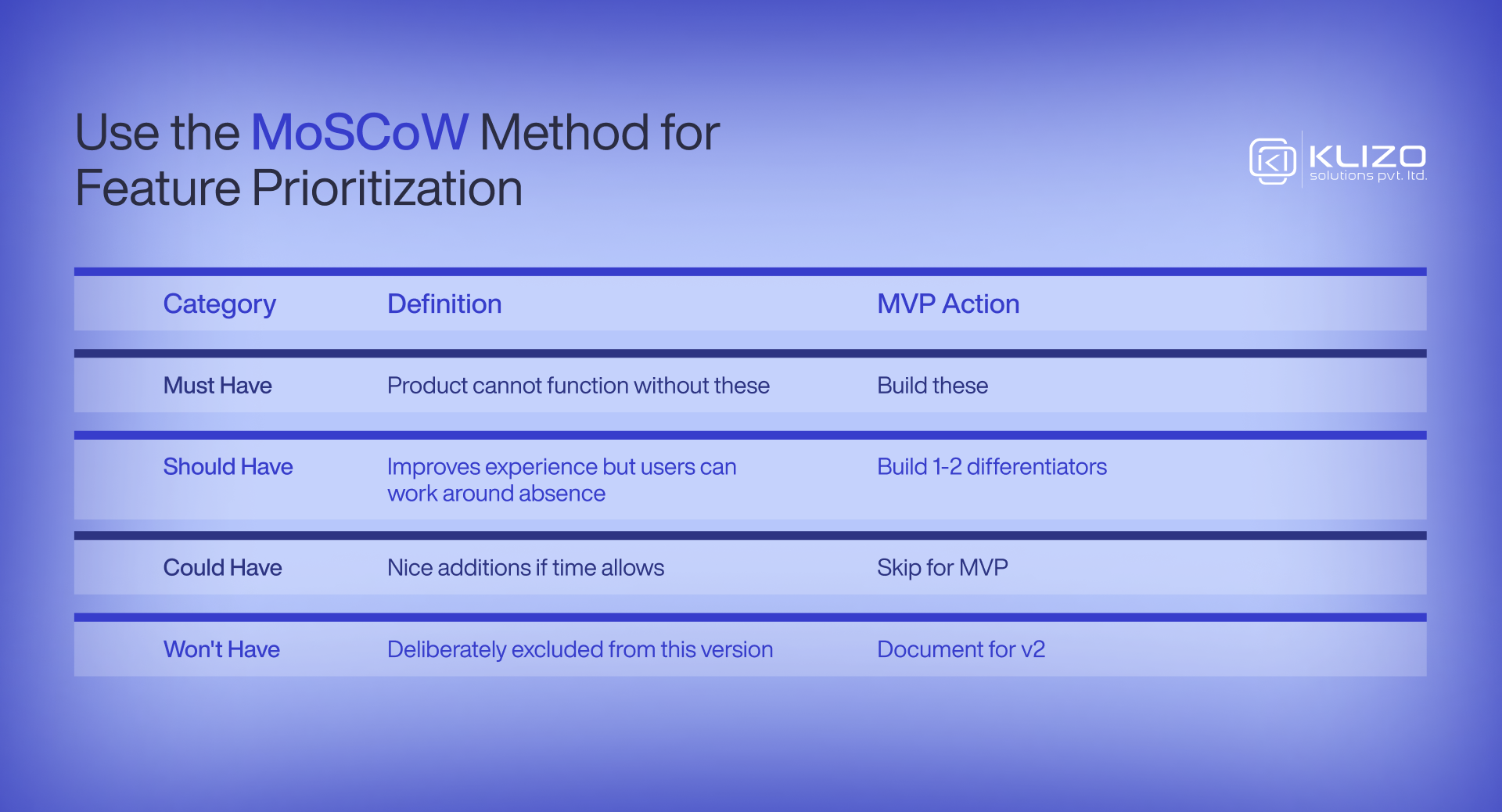
Apply RICE Scoring for Data-Driven Decisions
For each potential feature, calculate:
- Reach: How many users will use this feature per month?
- Impact: How much does it help them? (Score 0.25-3)
- Confidence: How sure are you about these estimates? (Percentage)
- Effort: How many developer-weeks to build?
Build the highest-scoring features first.
Timeline: 1 week | Cost: Included in design phase
Step 3: How Do You Design the User Experience for an MVP?
TL;DR: Start with wireframes, build interactive prototypes using AI design tools, focus on the happy path, and gather feedback before writing any code.
In 2026, users expect production-quality experiences from day one. “It is an MVP” is no longer an excuse for poor user experience.
Start with Wireframes
Begin with simple black-and-white wireframes that map out every screen in your core user journey. AI design tools can generate these in minutes – you describe the user flow, and the AI creates basic screen layouts.
Build Interactive Prototypes
Move from wireframes to clickable prototypes that users can test. Tools like Figma combined with AI plugins allow you to generate interactive prototypes rapidly. The goal is to test your core user journey with real people before writing any code.
Focus on the Happy Path
Do not design every possible scenario. Focus on the flow when everything goes right. Handle errors, edge cases, and empty states later.
Gather Feedback Early
Share your prototype with a small group of target users. Collect feedback on navigation, clarity, and whether the core value proposition comes through. This is your cheapest opportunity to catch fundamental UX problems.
At Klizo Solutions, our UI/UX team specializes in creating designs that are strategically structured to drive user engagement and conversion. We help you materialize your idea before a single line of code is written.
Timeline: 1-3 weeks | Cost: $8,000-$25,000
Suggested alt text: Side-by-side comparison of wireframe and interactive prototype for MVP design
Step 4: What Is the Best Tech Stack for an MVP in 2026?
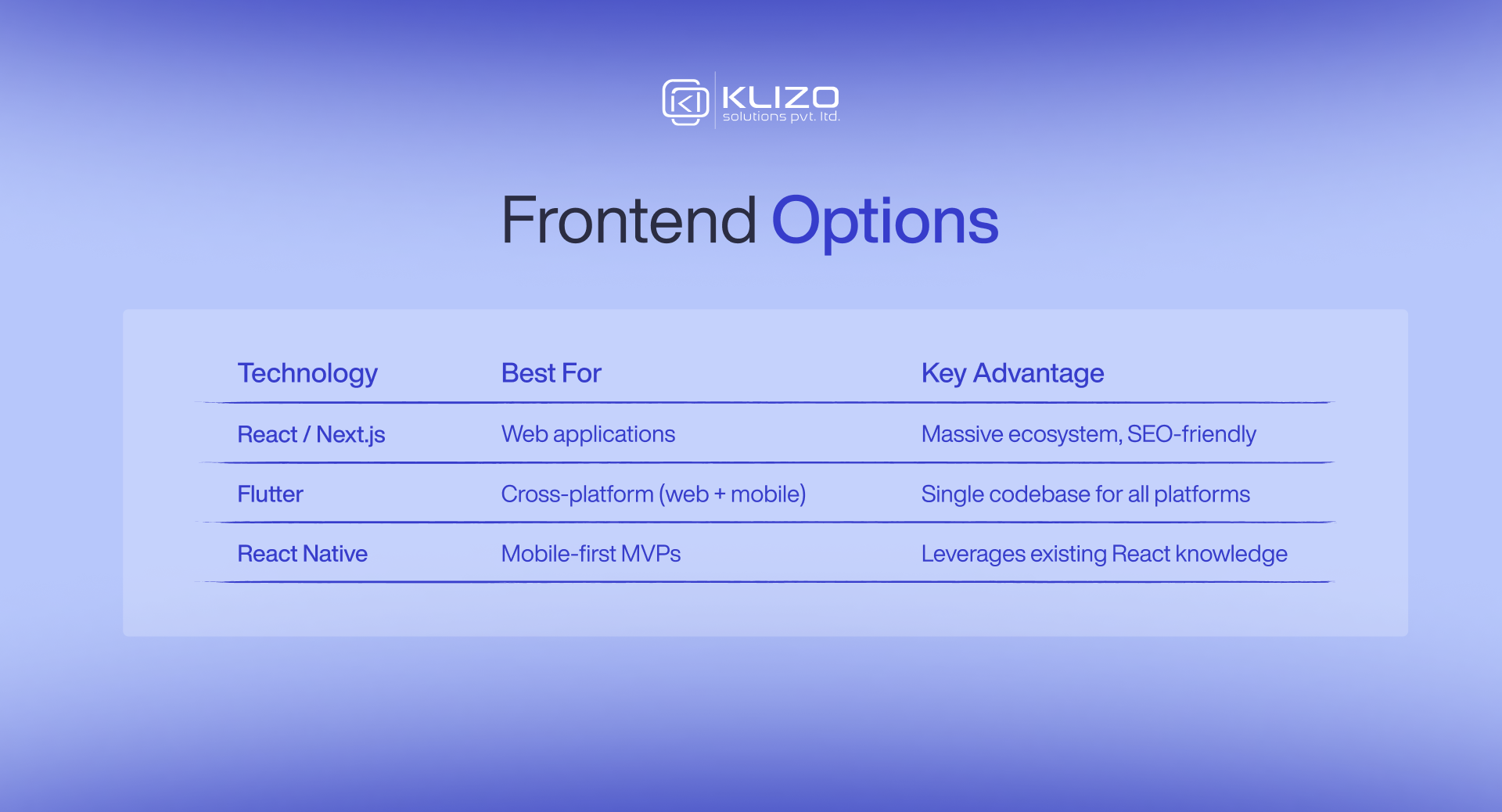
TL;DR: Choose React/Next.js or Flutter for frontend, Node.js or Python for backend, PostgreSQL or MongoDB for database, and OpenAI or Anthropic APIs for AI features. Prioritize speed over architectural perfection.
The technology decisions you make at the MVP stage have long-term consequences. Choose a stack that balances speed, cost efficiency, and future scalability.
Backend Options
- Node.js: Fast, JavaScript-based, excellent for real-time features and API-heavy applications
- Python (Django/FastAPI): Best choice if your MVP involves AI and machine learning features
- Laravel (PHP): Rapid development with excellent built-in tooling. At Klizo, we have a strong development team in Laravel and have used it to build robust custom platforms
Database Options
- PostgreSQL: Reliable, handles complex data relationships, excellent for SaaS products
- MongoDB: Flexible schema design, ideal for MVPs where data structures are still evolving. At Klizo, we have moved from MySQL to MongoDB for many projects because of its flexibility during early-stage development
- Firebase/Supabase: Fast setup, handles authentication and hosting, excellent for rapid prototyping
AI Integration Options
- OpenAI API (GPT-4): Most developer-friendly LLM for building AI-powered features
- Anthropic API (Claude): Strong contextual stability for nuanced reasoning
- Hugging Face: Open-source models for teams needing more control
Cloud Hosting
- AWS: Most features, best for teams with DevOps experience
- Google Cloud (GCP): Strong AI/ML tooling, good Firebase integration
- Vercel: Excellent for Next.js deployments, simple and fast
Key principle: Avoid over-engineering. Choose technologies your team knows well. Speed of execution matters more than architectural perfection when validating a product hypothesis.
Timeline: 1 week | Cost: Included in planning phase
Step 5: How Do You Build an MVP with AI-Assisted Development?
TL;DR: Use AI copilots (GitHub Copilot, Cursor) for 35% faster coding, AI-powered testing tools for automated bug detection, and AI documentation generators. Follow agile sprints with weekly build reviews.
This is where AI transforms the development process most dramatically. In 2026, AI is not replacing developers – it is making developers significantly more productive.
AI Code Generation and Copilots
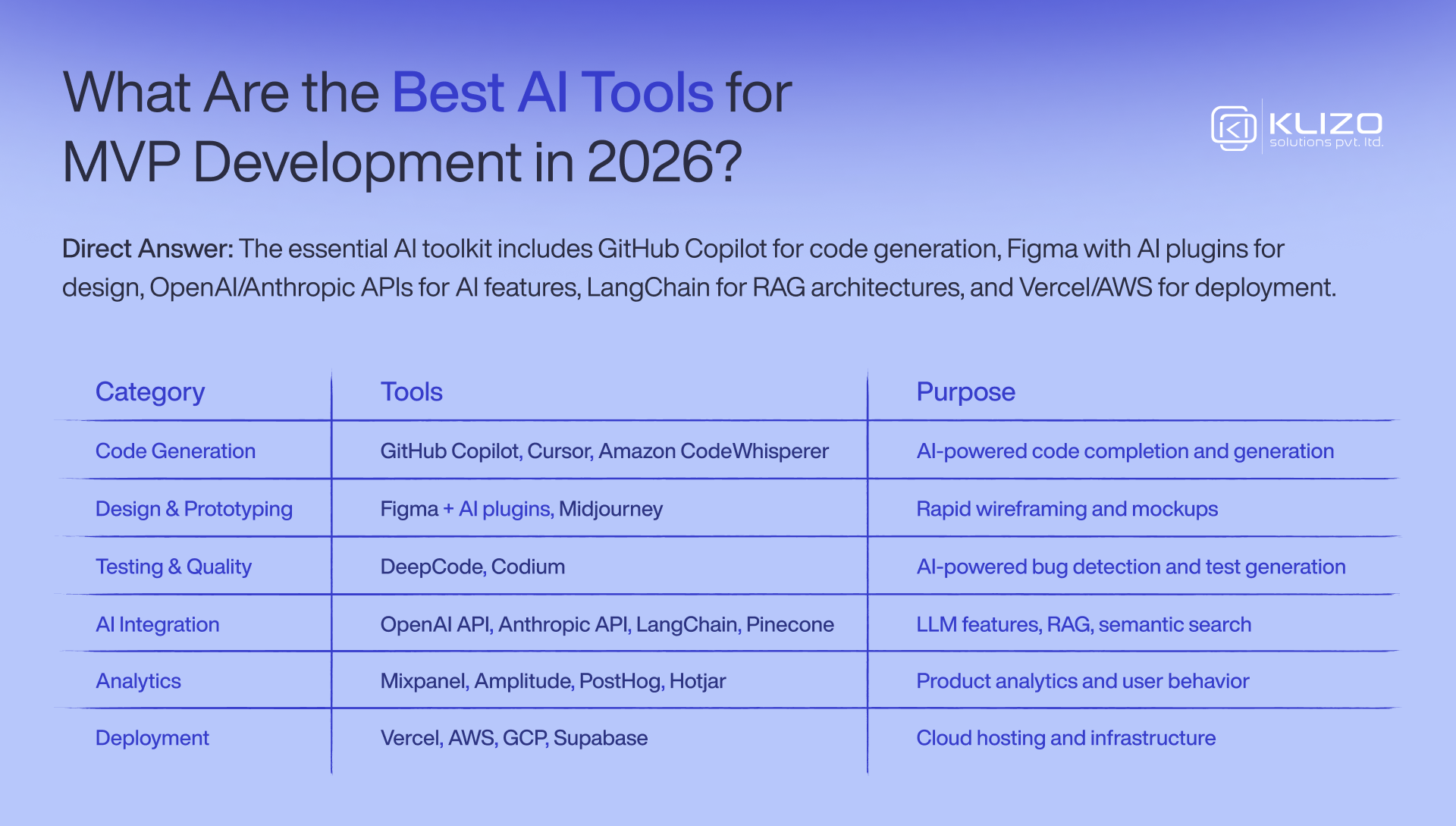
Tools like GitHub Copilot, Cursor, and Amazon CodeWhisperer have matured into genuine development accelerators. Teams report a 35 percent reduction in manual coding time on core modules when using AI copilots effectively.
How to use AI copilots effectively:
- Let AI handle CRUD operations, validation layers, and boilerplate patterns
- Developers review, refine, and ensure correctness
- Focus human effort on architecture, business logic, and quality
AI-Powered Testing and Debugging
AI tools like DeepCode and Codium scan your codebase continuously, identifying bugs, security vulnerabilities, and performance issues before they reach production. Automated test generation covers edge cases that human developers might miss.
AI for Documentation
AI tools can generate API documentation, code comments, and user guides automatically, ensuring your codebase remains understandable as your team grows.
Development Best Practices
- Use agile sprints – Break development into 1-2 week sprints with clear deliverables
- Run short build review cycles – Product, tech, and business teams should stay aligned weekly
- Validate continuously – Deploy incremental builds and gather feedback throughout
- Design for modularity – Use microservices or modular architecture so components can be updated independently
At Klizo Solutions, we have over 40 developers on staff working across Flutter, iOS, Android, React Native, Laravel, and modern JavaScript frameworks. Our teams have integrated advanced technologies from facial recognition and blockchain to custom data crawling aggregators and AI-powered email engines. We do not just build applications – we help you map out your idea, develop it with the right architecture, and launch it properly.
Timeline: 4-8 weeks | Cost: $15,000-$80,000 depending on complexity
Suggested alt text: Developer using AI copilot tool to write code for MVP development
Step 6: What AI Features Should You Include in Your MVP?
TL;DR: Start with one high-impact AI capability — recommendations, chatbots, content generation, or predictive analytics. Use hosted APIs (OpenAI, Anthropic) instead of training custom models. Implement RAG architecture for knowledge-driven products.
Common AI Features for MVPs in 2026
- AI-Powered Search and Recommendations: Use embeddings and vector databases like Pinecone or Weaviate for personalized content or product recommendations
- Conversational AI: Integrate ChatGPT or Claude to power customer support chatbots, onboarding assistants, or interactive product guides
- Automated Content Generation: Use LLMs to generate product descriptions, email sequences, reports, or summaries
- Predictive Analytics: Use ML models to predict user behavior, churn risk, or demand patterns
- Document Processing: Use AI to parse, summarize, and extract information from documents and contracts
What Is RAG Architecture and Why Does It Matter for MVPs?
Retrieval Augmented Generation (RAG) combines the reasoning capabilities of large language models with the accuracy of your own data. Instead of relying solely on the model’s training data, RAG retrieves relevant documents from your knowledge base and uses them to generate accurate, contextual responses.
As we discussed in our article on AI Agents Are Becoming Operating Systems, RAG has evolved into RAG 2.0, blending semantic search, graph search, structured pipelines, and hybrid scoring.
Keep AI Integration Lean
For an MVP, use hosted AI services through APIs rather than training custom models. OpenAI’s pay-per-use API charges cents per thousand tokens — perfect for MVPs. You can always move to custom models later when you have the data and budget to justify it.
Timeline: 2-4 weeks (concurrent with core development) | Cost: $5,000-$20,000
Step 7: How Do You Test an MVP Before Launch?
TL;DR: Conduct functional testing, performance testing, security testing, user acceptance testing with 5-10 real users, and AI output validation. An MVP is a minimum viable product, not a minimum quality product.
Functional Testing
Verify that every feature works as intended. Every button, form, API call, and payment flow must function correctly.
Performance Testing
Test load times, response times, and behavior under concurrent users. A slow MVP loses users before they experience your value proposition.
Security Testing
Especially critical if your MVP handles payments, personal data, or operates in regulated industries. At Klizo, we have built technology that complies with legal requirements for industries like cannabis retail, where ID and age verification during payment is mandatory.
User Acceptance Testing
Put the MVP in front of 5 to 10 real users from your target audience. Watch them use it. Note where they get confused, hesitate, or drop off.
AI Output Validation
If your MVP includes AI-generated content or decisions, validate quality and accuracy. As we explored in How AI Is Redefining Developer Roles, because AI models predict likelihood rather than correctness, developers must design systems that compensate for uncertainty.
Timeline: 2-3 weeks | Cost: $5,000-$15,000
Step 8: How Do You Launch an MVP Successfully?
TL;DR: Deploy to production with monitoring, launch to a small controlled audience first, build a marketing strategy (landing page, email, social, ads), and set up analytics tracking from day one.
Deploy to Production
Set up cloud infrastructure, configure domains, submit to app stores if applicable, and ensure monitoring and logging are in place.
Launch to a Small Audience First
Do not launch to the entire world on day one. Start with a controlled group of early adopters – your beta waitlist, a specific community, or a targeted market segment.
Build a Launch Marketing Strategy
Your MVP needs users to generate feedback:
- Landing page with clear value proposition and signup flow
- Email sequences for your waitlist
- Social media content announcing the launch
- Targeted ads on platforms where your audience spends time
- Content marketing and SEO to drive organic traffic
At Klizo, our digital marketing team helps startups build launch strategies that drive real user acquisition. We combine data-driven targeting with consistent content creation to lower acquisition costs while increasing conversions.

Timeline: 1-2 weeks | Cost: $3,000-$20,000
Suggested alt text: Dashboard showing MVP launch analytics with user signups, retention, and conversion metrics
Step 9: How Do You Iterate After Launching Your MVP?
TL;DR: Analyze user behavior data, collect and prioritize feedback using AI tools, ship improvements in 1-2 week cycles, and know when to pivot based on engagement data.
The launch is not the finish line. It is the starting line.
Analyze User Behavior
Use analytics to understand how users actually interact with your product versus how you expected them to. Look for drop-off points, underused features, and unexpected usage patterns.
Collect and Prioritize Feedback
Gather feedback through multiple channels: in-app surveys, user interviews, support tickets, and analytics data. Use AI tools to analyze and categorize feedback at scale.
Ship Improvements Rapidly
The advantage of AI-assisted development continues after launch. Use AI copilots to implement changes quickly. Run short iteration cycles of 1 to 2 weeks.
Know When to Pivot
If your data consistently shows that users are not engaging with your core value proposition, it may be time to pivot. This is not failure – this is the MVP process working as intended.
What Are the Most Common MVP Mistakes to Avoid?
Direct Answer: The top MVP killers are building too many features, skipping user validation, choosing the wrong tech stack, ignoring UX design, not planning for post-launch iteration, and adding AI features as gimmicks rather than solving real problems.
-
Building Too Many Features – Every feature increases development time, testing complexity, and bug risk. Ruthlessly cut anything non-essential.
-
Skipping User Validation – Building based on assumptions rather than evidence. Always validate with real users before and during development.
-
Choosing the Wrong Tech Stack – Over-engineering with enterprise-grade architecture when a simpler stack would ship faster.
-
Ignoring Design and UX – A functional product with terrible UX will not retain users. Invest in design.
-
Not Planning for Post-Launch – Without a plan for iteration, marketing, and user support, even a great MVP will stall. Budget for at least 3 months of post-launch iteration.
-
Treating AI as a Gimmick – Adding AI features because they sound impressive rather than because they solve a real user problem. As we discussed in our article on Answer Engine Optimization, the market in 2026 rewards substance over hype.
How Klizo Solutions Helps You Build Your MVP
At Klizo Solutions, we do not just write code. We help you think through your idea, validate it, design it, build it, and launch it into the market.
What makes working with Klizo different:
- Full-Cycle Development: From UI/UX design to app development to web applications, we handle every phase under one roof
- Cross-Platform Expertise: 40+ developers across Flutter, React Native, iOS, Android, Laravel, Node.js, Python, and modern JavaScript frameworks
- AI-Native Development: We build AI-powered systems using agentic architectures, RAG pipelines, and LLM integrations
- Industry Experience: Products across real estate, e-commerce, cannabis compliance, crypto payments, and more
- Startup-Friendly Engagement: Full development teams or virtual hires to fill specific gaps
- Post-Launch Support: We do not disappear after launch. We support clients through iteration, scaling, and growth
Conclusion: The Best Time to Build Your MVP Is Now
The barriers to building a technology product have never been lower. AI-assisted development has compressed timelines, reduced costs, and elevated quality to levels that were unimaginable even two years ago.
But the tools alone are not enough. Building a successful MVP still requires clear problem definition, disciplined feature prioritization, thoughtful design, rigorous testing, and strategic launch execution. AI accelerates every one of these steps, but it does not replace the human judgment that guides them.
The startups that win in 2026 are not the ones with the most features or the biggest budgets. They are the ones that validate fastest, learn continuously, and iterate relentlessly.
If you have an idea and you are ready to build, talk to our team at Klizo Solutions. We will help you formulate your idea, estimate the hours and complexity, and build a product that works.
Frequently Asked Questions
How long does it take to build an MVP in 2026?
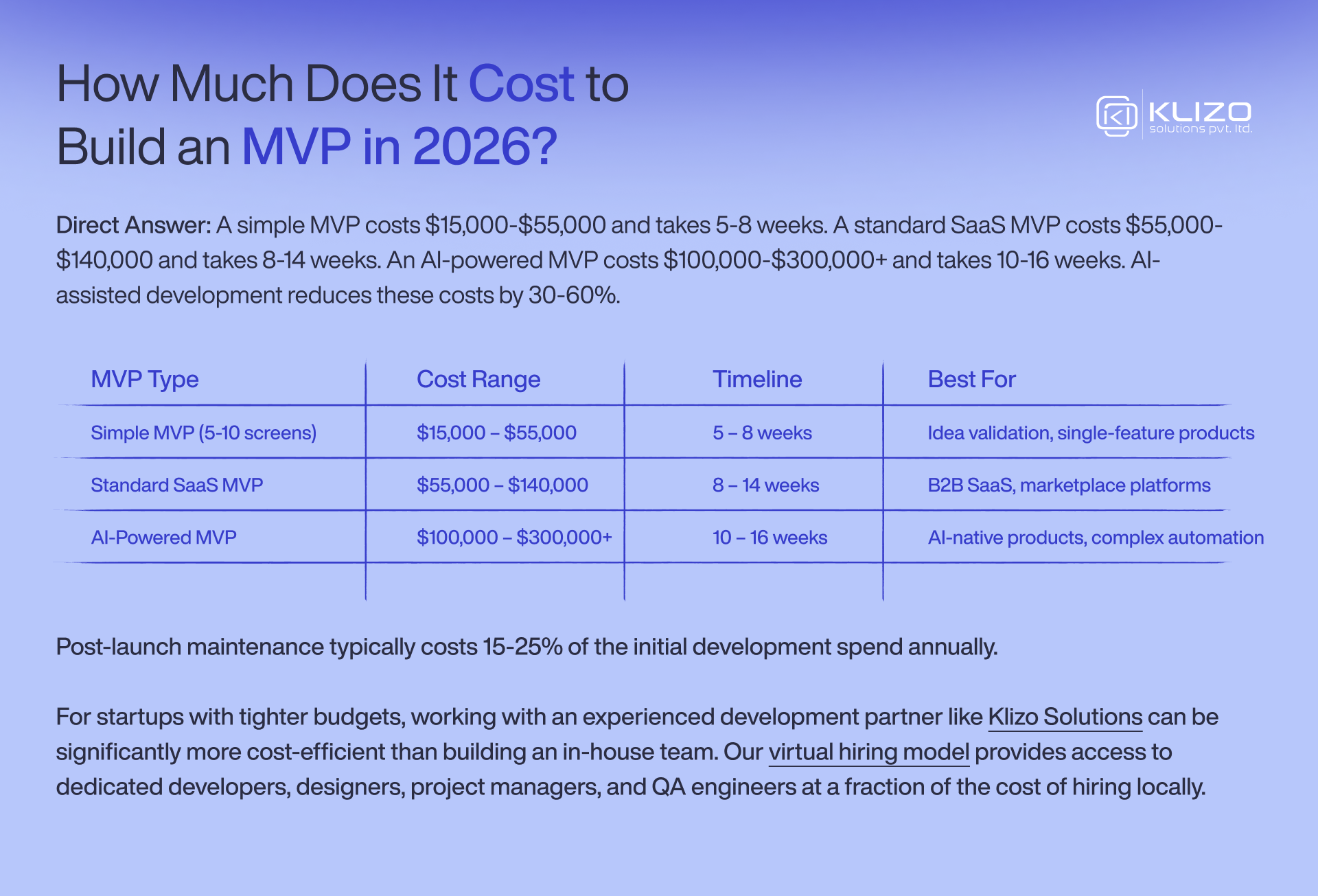
A simple MVP takes 5-8 weeks, a standard SaaS MVP takes 8-14 weeks, and an AI-powered MVP takes 10-16 weeks. AI-assisted development compresses these timelines by 30-60% compared to traditional approaches.
How much does MVP development cost in 2026?
Simple MVPs range from $15,000 to $55,000. Standard SaaS MVPs cost $55,000 to $140,000. AI-powered MVPs can range from $100,000 to $300,000 or more. Working with an experienced offshore development partner reduces these costs significantly.
What AI tools should I use to build my MVP?
GitHub Copilot for code generation, Figma for design, OpenAI or Anthropic APIs for AI features, LangChain for RAG architectures, and Vercel or AWS for deployment. The specific tools depend on your product requirements and tech stack.
Can I build an MVP without a technical co-founder?
Yes. In 2026, non-technical founders have more options than ever – from AI builder tools for initial validation to development partners like Klizo Solutions who handle the entire technical execution.
What is the difference between an MVP and a prototype?
A prototype is a visual demo that looks real but does not function. An MVP is a working product that real users can interact with, pay for, and provide feedback on. Only an MVP gives you real market validation.
What is the best tech stack for an MVP in 2026?
For most startups: React or Next.js for web frontend, Flutter or React Native for mobile, Node.js or Python for backend, PostgreSQL or MongoDB for database, and OpenAI API for AI features. Choose technologies your team knows well – speed matters more than perfection at the MVP stage.
How does AI reduce MVP development costs?
AI copilots automate repetitive coding tasks (35% reduction in manual coding time), AI testing tools catch bugs faster, AI generates documentation automatically, and AI-powered market research replaces weeks of manual analysis. Combined, these efficiencies reduce total MVP costs by 30-60%.


