

Employee monitoring is usually discussed in the wrong way.
Most people hear the term and immediately think about surveillance, screenshots, mouse clicks, and managers watching employees every minute of the day.
That is not where this market is going.
The real future of employee monitoring is not about a manager manually checking every employee’s screen.
The real future is using workplace data to understand how work is being done, where risk exists, what can be automated, and how employees can move into higher-value roles by managing AI agents instead of doing repetitive tasks themselves.
That is the bigger conversation.
We are already seeing this shift happen at the largest technology companies in the world. BBC News reported that Meta started installing tracking software on U.S.-based employee computers to capture mouse movements, clicks, keystrokes, and occasional screen snapshots for AI training. The reported goal was not just “monitoring” in the old sense. It was part of a broader effort to build AI agents capable of performing routine computer-based work autonomously.
The Register also reported leaked audio where Mark Zuckerberg allegedly defended employee monitoring as part of the AI race, arguing that companies need real examples of how people work on computers if they want to build better AI systems.
People can debate whether Meta handled the communication properly. That is a fair debate.
But the direction is obvious.
Companies are no longer just asking, “Is this employee active?”
They are starting to ask:
- How is this work actually being done?
- Which tasks are repetitive?
- Which workflows can be automated?
- Which roles should be redesigned around AI?
- Which employees can be upskilled into managing agents?
- Which processes are too slow, too manual, or too expensive?
- Where are the security and compliance risks?
That is the real future of productivity monitoring.
Monitoring Is No Longer Just About Productivity
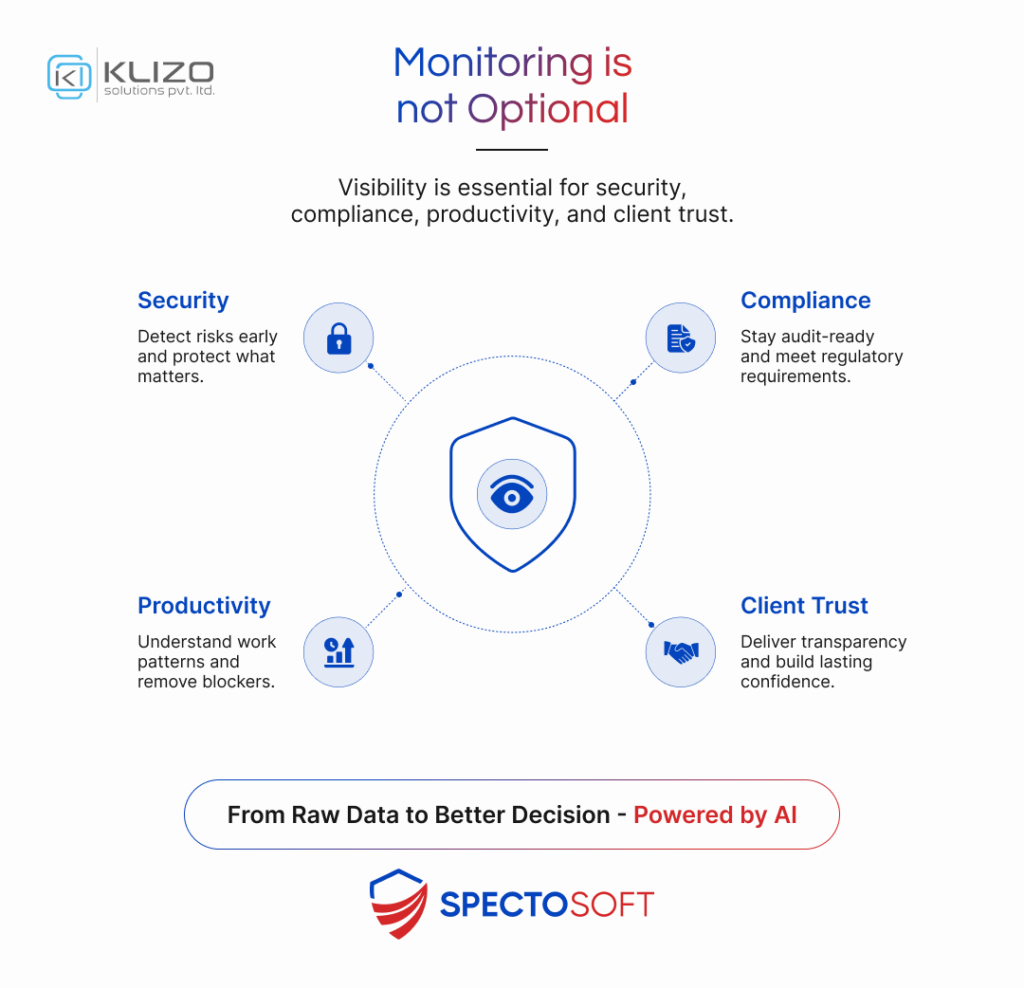
In a serious software company, monitoring is not optional.
When teams work with source code, production systems, API keys, client data, payment workflows, cloud infrastructure, and sensitive business information, the company has a responsibility to know what is happening inside its environment.
A client should not hire a development company that has no visibility into how its team is working, who is accessing systems, whether company time is being used properly, or whether sensitive information is being handled responsibly.
That is not paranoia. That is basic operational discipline.
Monitoring helps identify who is delivering, who is wasting time, who may be misusing company systems, and where the company has security or compliance exposure. It also helps protect good employees because the people actually doing the work become easier to recognize.
The mistake is thinking monitoring should stop there.
The next layer is intelligence.
The Real Opportunity Is AI Analysis
No company should want managers spending hours manually reviewing screenshots and time logs.
That is low-value work.
If the monitoring system collects data but still requires a human to manually inspect everything, the company has only solved half the problem.
The better model is AI-powered analysis.
AI should be able to review work patterns, summarize activity, detect unusual behavior, identify wasted time, flag potential data risks, and show which workflows are being repeated over and over again.
The system should not just say, “This person was active for seven hours.”
It should help answer:
- Did this person work on the right project?
- Did they use the right tools?
- Did their activity match their assigned tasks?
- Did they access sensitive systems unnecessarily?
- Did they spend time on personal or unrelated work?
- Did the workflow include repetitive steps that could be automated?
- Did this person produce real output or just activity?
That is the difference between raw monitoring and management intelligence.
Where Spectosoft Fits In
This is exactly the problem Spectosoft is built to solve.
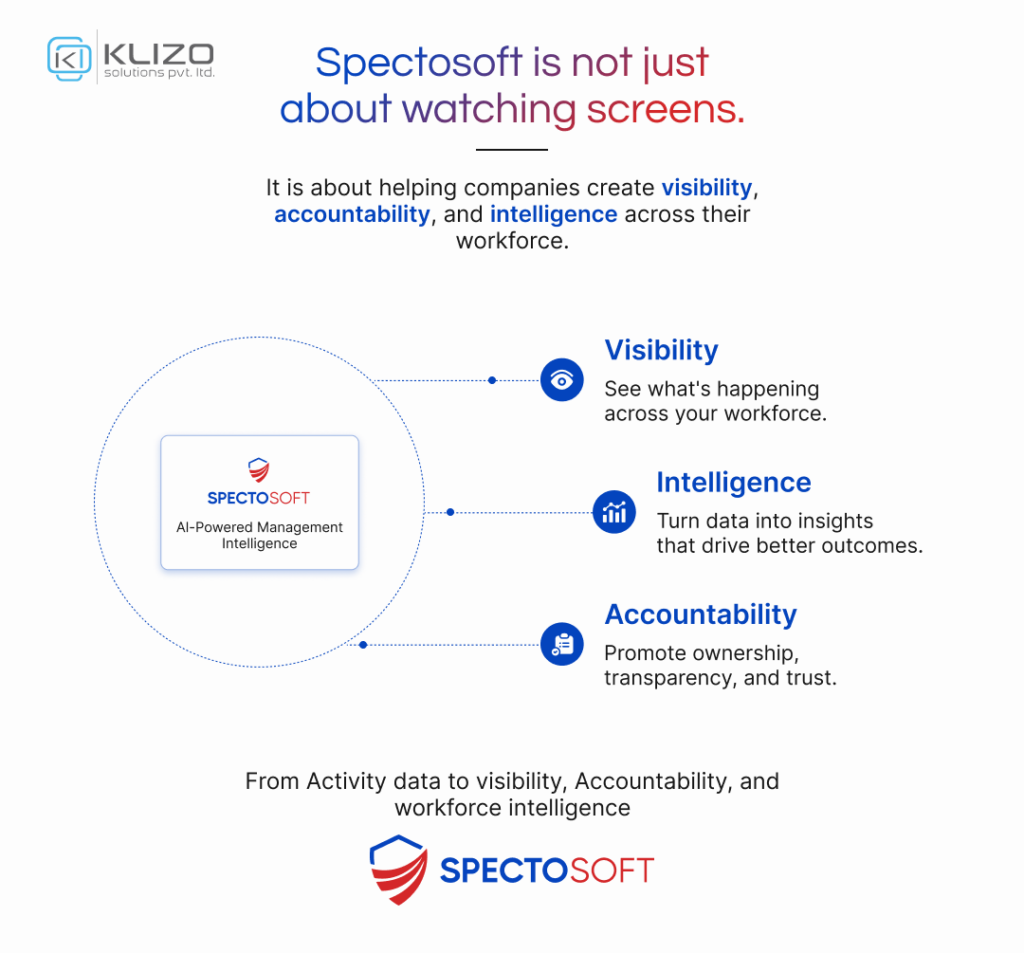
Spectosoft is not just about watching screens. It is about helping companies create visibility, accountability, and intelligence across their workforce.
For remote teams, hybrid teams, software companies, agencies, finance teams, support teams, operations teams, and businesses handling sensitive client work, Spectosoft gives leadership a clearer picture of what is actually happening during the workday.
It helps companies see:
- Who is actively working
- Which apps and websites are being used
- How time is being spent
- Where productivity is strong
- Where productivity is weak
- Which employees may need support
- Which employees are consistently delivering
- Which behavior may create security or compliance risk
- Which workflows are repetitive and ready for automation
- Which roles may need to evolve as AI agents become part of the business
This matters because raw data by itself is not enough.
A screenshot is just a screenshot. A time log is just a time log. An activity score is just a signal.
The value comes from turning all of that into useful decisions.
That is where Spectosoft can become more than a monitoring tool. It can become a management intelligence layer for the company.
Instead of leadership guessing what is happening, Spectosoft helps them understand the reality of work across teams, departments, projects, and locations.
Instead of waiting until a project is late, a client complains, or a security issue appears, companies can identify problems earlier.
Instead of relying only on what employees say in daily updates, managers can compare updates against real work behavior and actual output.
Instead of treating every employee the same, leadership can identify the high performers, support the people who are struggling, and address the people who are misusing company time.
That is a much better way to run a company.
The Bigger Shift: From Employees Doing Tasks to Employees Managing Agents
The most important part of this conversation is not “catching people.”
The most important part is identifying what work should no longer be done manually.
This is already happening across many business functions.
In sales, AI can research accounts, summarize prospects, generate sales insights, draft outreach, score leads, prepare call notes, update CRM records, and recommend follow-up actions.
For SDR teams, AI agents can already handle parts of prospecting, enrichment, email drafting, sequencing, call preparation, and pipeline research.
In recruiting, AI can screen resumes, summarize candidates, rank applicants, generate interview questions, and identify top-fit profiles.
In support, AI agents can handle first responses, summarize tickets, escalate urgent issues, and suggest resolutions.
In operations, AI can generate reports, compare documents, extract data, monitor workflows, and detect exceptions.
In software development, AI can assist with code generation, testing, documentation, debugging, log analysis, and QA workflows.
This does not mean every employee disappears.
It means the job changes.
The employee who used to manually do the task may now supervise the agent, improve the workflow, check the output, handle exceptions, and apply judgment where AI is not good enough yet.
That is where companies should be moving.
Not just “replace people with AI.”
A better approach is:
- Identify repetitive work.
- Build or deploy an AI agent to handle the repeatable part.
- Train the employee to manage, review, and improve the agent.
- Move the employee toward higher-value work.
- Measure whether the new workflow is faster, cheaper, and better.
Spectosoft can help companies get to step one.
Before a business can automate work, it first has to understand the work.
Where is time being spent? Which tasks repeat every day? Which tools are being used? Which workflows are slowing people down? Which employees are stuck in low-value manual work? Which teams are creating results, and which teams are creating activity without outcomes?
That visibility is the foundation for automation.
Without it, companies are guessing.
With it, companies can make smarter decisions about where AI agents should be introduced first.
Cost of Intelligence Will Matter More Than Headcount
The business question is changing.
Companies used to ask, “How many people do we need to do this?”
Now they will ask, “How much intelligence does this task require, and what is the cheapest, most reliable way to apply that intelligence?”
Sometimes the answer will still be a person. Sometimes it will be a person supported by AI. Sometimes it will be an AI agent with a human reviewing exceptions. Sometimes the task should disappear completely because it was never valuable in the first place.
This is where productivity monitoring becomes extremely useful.
If a company can see how people actually work, it can identify what should be automated, what should be improved, and what should be eliminated.
It can see where employees are spending hours on tasks that AI can do in minutes.
It can be seen that managers are asking for reports that no one uses.
It can see where developers, salespeople, support teams, recruiters, and operations staff are stuck in repetitive workflows instead of doing higher-value work.
That is not just monitoring. That is process intelligence.
And this is one of the biggest opportunities for platforms like Spectosoft.
A company should not only use monitoring data to ask, “Who is working?”
It should also ask, “What work should not need a human anymore?”
That is how businesses will reduce waste, improve margins, and help their best employees move into more valuable roles.
Good Employees Should Benefit From This
A good employee should not be afraid of accountability.
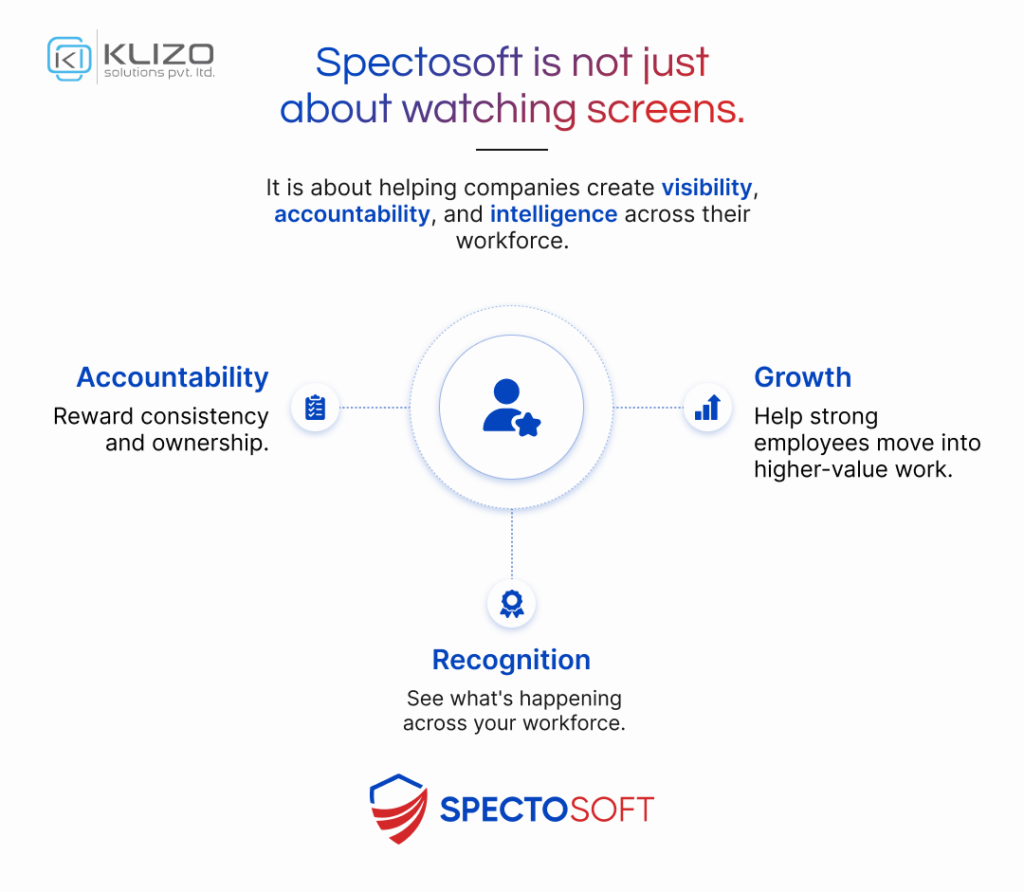
If someone is producing real value, monitoring can help prove it.
It shows who is actually carrying the load. It shows who is reliable. It shows who is solving problems. It shows who is improving with better tools.
The employees who will win in this next phase are not the people who hide from monitoring or complain about AI.
The winners will be the people who learn how to use AI to produce more, manage agents, improve workflows, and become more valuable to the company.
That is the mindset shift.
The future employee is not just a task-doe
The future employee is an operator of systems.
They will manage AI agents, validate outputs, improve prompts, handle exceptions, maintain quality, and use judgment where automation is not enough.
That is a better job than copying data, writing repetitive reports, manually checking activity logs, or doing the same low-value task every day.
A tool like Spectosoft helps makes that transition easier because it gives companies the visibility needed to understand which tasks are actually happening, how often they happen, and where employees can be moved into more meaningful work.
The goal should not be to punish good people.
The goal should be to build a more intelligent company.
Security, Compliance, and Client Trust
There is another reason this matters: security.
Companies today are working with more sensitive data than ever.
Developers touch repositories, databases, credentials, cloud systems, API keys, payment flows, internal dashboards, customer information, and client IP.
Sales teams touch CRM data, customer lists, pricing, contracts, and confidential deal information
Finance and operations teams touch invoices, banking details, payroll, reports, and vendor information.
If a company cannot monitor how that information is accessed and handled, it is exposed.
For companies moving toward SOC 2, stronger internal controls, enterprise clients, financial workflows, or regulated industries, visibility is not optional.
Spectosoft helps companies strengthen that visibility by giving them a clearer view of employee activity, software usage, time patterns, and potential risks.
That does not replace a full compliance program.
But it supports the discipline a company needs to operate professionally.
Security is not just about firewalls.
Security is also about knowing what is happening inside the company.
Final Thoughts
Employee monitoring is not just about watching people.
It is becoming a way for companies to understand work, protect client data, improve security, identify waste, and prepare for AI-driven operations.
Meta’s reported use of employee activity data to train AI is a sign of where the market is going. Whether people like it or not, companies are going to study how work happens so they can automate the repetitive parts and redesign roles around AI.
The companies that do this well will not simply replace people blindly.
They will identify the work that should be automated, move employees into higher-value roles, and build teams where people manage intelligent systems instead of wasting time on tasks an agent could have done faster.
That is where Spectosoft becomes valuable.
Spectosoft helps companies move from guessing to knowing.
It helps leadership understand productivity, risk, software usage, team behavior, and opportunities for automation.
It helps identify strong employees, struggling employees, risky behavior, wasted time, and workflows that can be improved with AI.
That is the future of productivity monitoring.
Not surveillance. Management intelligence. Not just tracking work. Redesigning work.
And for companies that want to compete in the AI era, that visibility is no longer optional.