


Introduction: How AI Is Redefining Developer Roles Today
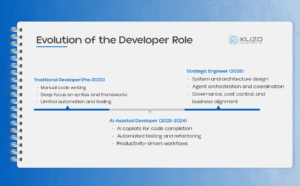
The way software developers work is undergoing a fundamental transformation. For decades, development was centered around manual coding, framework expertise, and writing logic line by line. Productivity was measured by how quickly a developer could implement features, fix bugs, and ship releases.
Today, AI is redefining developer roles in ways that go far beyond faster coding. In 2026, developers are no longer valued only for writing syntax correctly. They are increasingly expected to design intelligent systems, guide AI behavior, and make strategic architectural decisions that shape business outcomes.
This shift does not mean developers are becoming less important. In fact, it means the opposite. As AI systems take over repetitive execution, the role of the developer becomes more strategic, more architectural, and more tightly connected to product and business goals.
In this article, we explore how AI is redefining developer roles from the ground up. We start with a beginner-friendly explanation, then move into deep technical topics such as architecture, multimodality, and model internals. We also examine real-world use cases, business implications, risks, governance, and how Klizo helps organizations navigate this transition.
A Beginner View What AI Is Doing in Developer Workflows
For developers who are new to this shift, the impact of AI can seem abstract. In practice, AI is already deeply embedded in everyday development workflows.
Today, AI-assisted development commonly includes automated code generation, test creation, bug detection, documentation writing, and refactoring suggestions. These capabilities dramatically reduce repetitive work and accelerate development cycles.
However, the real change lies beneath the surface. AI systems are trained on vast amounts of open-source code and documentation. They learn patterns related to architecture, performance tradeoffs, and best practices. When used correctly, this allows developers to operate at a higher level of abstraction.
When used without oversight, these same systems can introduce subtle bugs, security vulnerabilities, and long-term technical debt. This is why AI redefining developer roles also requires developers to take on greater responsibility for validation and control.
The Technical Core: How AI Is Redefining Developer Roles Through Architecture
Model Internals and Code Reasoning
Modern AI coding systems are typically built on large language models trained on a combination of natural language, source code, and technical documentation. These models do not understand code in the way humans do. Instead, they predict likely sequences of tokens based on patterns learned during training.
Despite this limitation, AI systems demonstrate impressive reasoning abilities. They implicitly learn control flow, data flow, dependency relationships, and architectural conventions. This allows them to generate code that appears logically coherent and contextually appropriate.
Because these models predict likelihood rather than correctness, developers must design systems that compensate for uncertainty. Validation layers, automated tests, and human review processes become critical. In this way, AI is redefining developer roles by shifting responsibility from writing code to ensuring correctness and reliability at the system level.
Context Windows and Memory Design
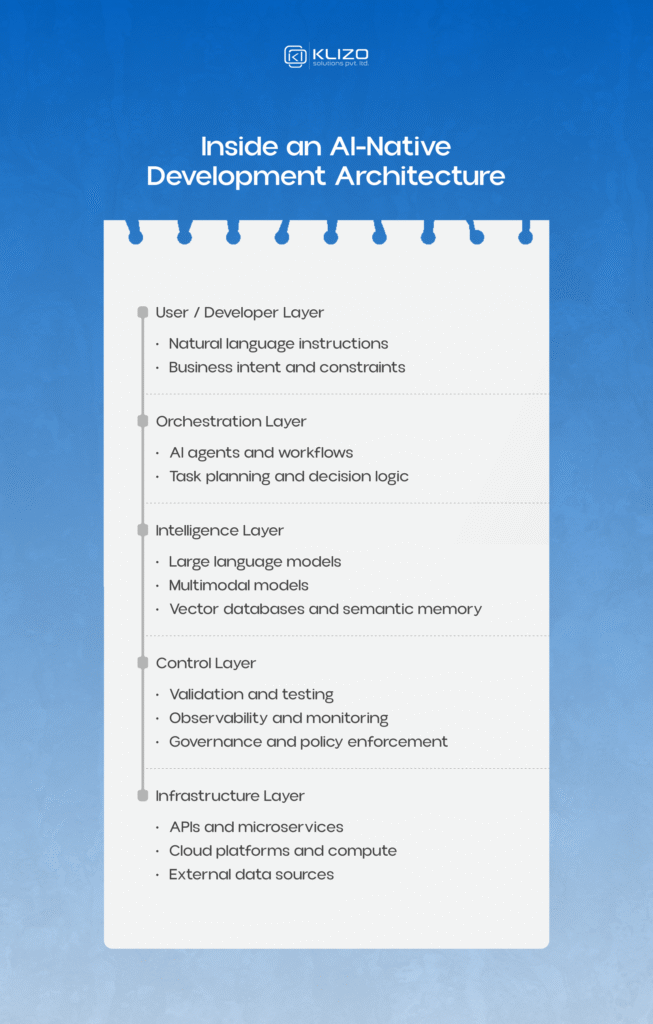
Another technical factor driving this shift is context management. AI models operate within finite context windows and cannot see an entire codebase unless developers explicitly design mechanisms for memory and retrieval.
This has led to the rise of architectural patterns such as semantic search, vector databases, hierarchical memory, and task-based context loading. Developers now decide what information the AI sees, when it sees it, and how it uses that information.
Designing context is no longer a secondary concern. It is a core architectural responsibility. This further reinforces how AI is redefining developer roles from implementers to system designers.
Multimodality and the Expanding Scope of Developer Roles
AI systems are no longer limited to processing text and code. Modern models are multimodal, meaning they can reason across images, audio, video, diagrams, and structured data.
This dramatically expands the scope of the developer role. Developers building AI-native systems may need to orchestrate visual inputs such as screenshots or camera feeds, audio inputs like speech, structured data from APIs, and textual instructions simultaneously.
The challenge is not writing logic for each input type. The challenge is designing how these inputs interact, how conflicts are resolved, and how confidence is measured. For example, an AI debugging assistant might combine logs, screenshots, and spoken user feedback to diagnose issues.
In these systems, AI is redefining developer roles into something closer to systems engineering and decision modeling rather than traditional programming.
Agentic Architectures: How AI Is Redefining Developer Roles Further
One of the most significant developments in 2026 is the rise of agentic AI systems. An AI agent is not just a function or a prompt. It is an entity that can plan actions, execute tasks, observe results, and adjust its behavior over time.
Agentic systems introduce new design challenges. Developers must think about task delegation, agent communication, permission boundaries, error recovery, and cost management. Instead of writing linear workflows, developers design ecosystems of interacting agents.
This requires a mindset similar to distributed systems engineering. Developers must anticipate emergent behavior, feedback loops, and failure modes. Once again, AI is redefining developer roles by demanding higher-level architectural thinking.
Why this works
Business Implications Why AI Redefining Developer Roles Matters
Productivity and Cost Optimization
From a business perspective, AI-assisted development can significantly increase productivity. Teams can ship features faster and experiment more aggressively. However, these benefits only materialize when AI systems are designed strategically.
Organizations that treat AI as a shortcut often accumulate hidden costs through fragile systems, security gaps, and unclear accountability. Organizations that treat AI as a strategic collaborator gain speed without sacrificing stability.
Hiring and Skill Evolution
As AI is redefining developer roles, hiring criteria are changing. Companies increasingly prioritize system design skills, architectural thinking, and the ability to evaluate AI-generated output critically.
Developers who understand observability, governance, and cost management are becoming more valuable than those who specialize narrowly in a single framework. This shift has long-term implications for education, training, and career development.
Real World Use Cases Where AI Is Redefining Developer Roles
Across industries, the impact of AI on developer roles is already visible.
In fintech, AI agents assist with fraud detection and regulatory reporting while developers focus on escalation logic and compliance controls. In healthcare, multimodal AI systems analyze medical images and patient records, with developers responsible for safety and interpretability.
In recruitment and HR, AI systems screen candidates and summarize interviews. Developers design fairness constraints, explainability mechanisms, and human override workflows. In SaaS products, AI copilots personalize experiences and automate support, while developers shape trust boundaries and performance guarantees.
In every case, AI is redefining developer roles away from manual coding and toward strategic orchestration.
Risks and Governance When AI Redefines Developer Roles
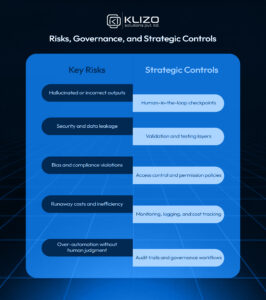
As AI systems become more powerful, the risks increase. Hallucinated outputs, silent failures, security breaches, bias, and runaway costs are common failure modes.
Governance is no longer optional. Developers must design systems with human-in-the-loop checkpoints, validation layers, monitoring, and audit trails. Responsible AI is not about slowing innovation. It is about making systems resilient and trustworthy.
How Klizo Helps Organizations Where AI Is Redefining Developer Roles
At Klizo, we help organizations adapt to the reality that AI is redefining developer roles. We design AI-native architectures that are observable, scalable, and governed by clear controls.
Our teams work across agent-based systems, multimodal pipelines, and enterprise-grade AI infrastructure. We help developers transition from manual execution to strategic engineering while aligning AI initiatives with real business outcomes.
Conclusion The Future of Development in an AI-Driven World
AI is not replacing developers. It is reshaping what it means to be a developer.
As AI takes over repetitive tasks, the value of developers shifts toward system design, decision-making, and governance. Developers who embrace this change become strategic partners to AI rather than competitors.
AI redefining developer roles is not a temporary trend. It is the new baseline for modern software engineering.
Frequently Asked Questions About AI Redefining Developer Roles
Will AI eliminate developer jobs
AI reduces the need for purely manual coding roles but increases demand for strategic engineers and system designers.
Do developers still need to learn programming languages
Yes. Programming knowledge remains essential, but it must be combined with architectural and strategic skills.
How can teams avoid AI-generated technical debt
By implementing validation, observability, and human oversight from the beginning.
Is agentic AI safe for production systems
Yes, when designed with clear boundaries, monitoring, and fallback mechanisms.
How should companies start adapting
Start small, augment existing workflows, and invest in governance early.


