


Kubernetes has become the de facto standard for container orchestration, powering applications across startups, enterprises, and hyperscale cloud providers. But one of the most challenging aspects of Kubernetes is networking. How do thousands of ephemeral pods communicate seamlessly across nodes, namespaces, and clusters while remaining secure and observable? The answer lies in Kubernetes networking and the Container Network Interface (CNI).
In this long-form guide, we will break down Kubernetes networking fundamentals, explain how CNIs work, and take a deep dive into popular CNI plugins — including Calico, Flannel, Cilium, Weave, and Canal. By the end of this article, you’ll know the strengths, trade-offs, and ideal use cases of each plugin. For an in-depth performance comparison, benchmarks, and real-world best practices, head to Part 2: https://careers.klizos.com/kubernetes-cni-part2-benchmarks/.
Understanding Kubernetes Networking Basics
Unlike traditional networking, where virtual machines often have static IP addresses and are connected via hypervisors, Kubernetes networking is dynamic. Pods are ephemeral — they can be created, destroyed, and rescheduled across nodes at any moment. This creates unique challenges in ensuring consistent connectivity and security.
Kubernetes does not provide a default CNI plugin. Instead, it defines the Container Network Interface (CNI) specification (https://github.com/containernetworking/cni). CNIs are pluggable components that handle pod-to-pod communication, IP address management, routing, and policy enforcement.
For networking engineers and DevOps teams, this abstraction provides flexibility — but it also means choosing the right CNI plugin is critical for scaling clusters effectively.
Overlay vs Underlay Networking in Kubernetes
Kubernetes networking strategies generally fall into two categories: overlay and underlay.
– Overlay (e.g., Flannel, Weave): Encapsulates packets into VXLAN or IP-in-IP tunnels. This makes setup simple, as it requires minimal interaction with the underlying physical network. However, overlays add latency (10–20%) and CPU overhead.
– Underlay (e.g., Calico with BGP): Uses real IP routing via BGP. This provides lower latency and better throughput, but requires integration with existing network infrastructure.
– eBPF dataplane (e.g., Cilium): A modern approach using Linux eBPF to bypass iptables and process packets at kernel level with minimal overhead. This enables powerful observability and security features.
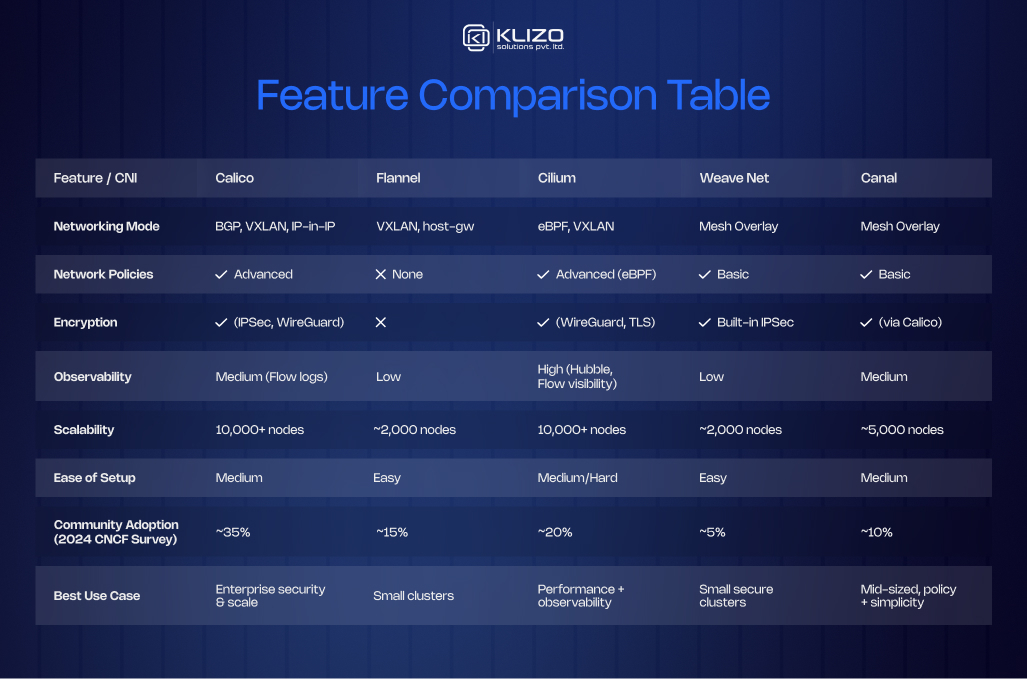
Deep Dive into Kubernetes CNI Plugins
-
Calico (https://projectcalico.docs.tigera.io/)
– Dataplane: Layer 3 routing using BGP, with optional eBPF mode.
– Strengths: Enterprise-grade security, NetworkPolicies, WireGuard/IPSec encryption, proven scalability (10,000+ nodes).
– Weaknesses: Requires networking expertise and BGP knowledge.
– Ideal For: Enterprises with strict compliance (finance, healthcare, government). -
Flannel (https://github.com/flannel-io/flannel)
– Dataplane: VXLAN or host-gw overlays.
– Strengths: Simple, lightweight, very easy to install.
– Weaknesses: No NetworkPolicy support, performance overhead due to overlays.
– Ideal For: Small dev/test clusters where simplicity trumps performance. -
Cilium (https://cilium.io/)
– Dataplane: eBPF-powered dataplane operating in the Linux kernel.
– Strengths: Best-in-class performance, advanced observability (via Hubble), built-in service mesh, multi-cluster support.
– Weaknesses: Newer technology with a learning curve.
– Ideal For: AI/ML, fintech, high-throughput applications, multi-cloud environments. -
Weave Net (https://kubernetes.io/docs/tasks/administer-cluster/network-policy-provider/weave-network-policy/)
– Dataplane: Mesh overlay using gossip-based discovery.
– Strengths: Simple deployment, built-in encryption.
– Weaknesses: Limited scalability (~2000 nodes), slower throughput.
– Ideal For: Small teams prioritizing encrypted communication. -
Canal (https://docs.projectcalico.org/getting-started/kubernetes/flannel/flannel)
– Dataplane: Flannel VXLAN overlays with Calico NetworkPolicies.
– Strengths: Combines the simplicity of Flannel with Calico’s policy enforcement.
– Weaknesses: Inherits Flannel’s overlay performance limitations.
– Ideal For: Mid-sized clusters transitioning from Flannel to Calico.
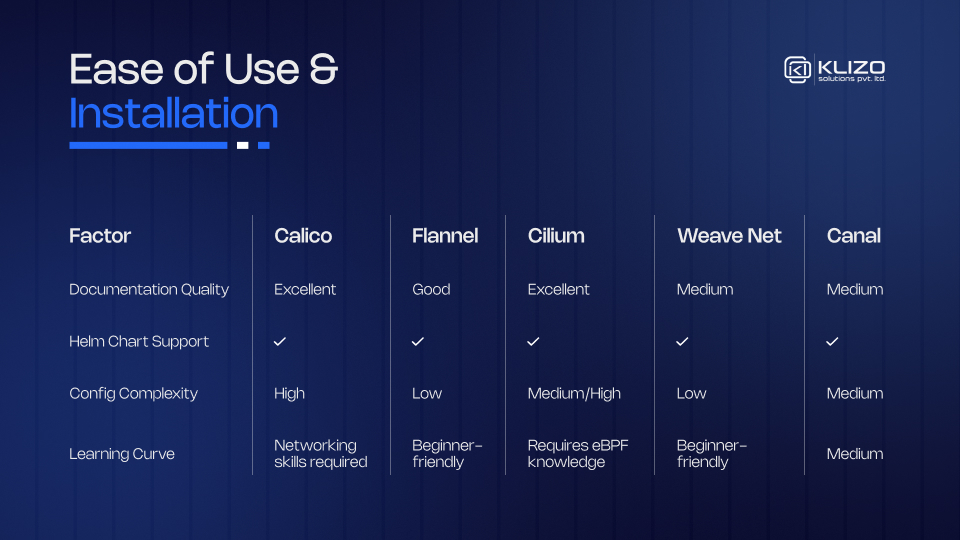
Frequently Asked Questions
Q1: What’s the default CNI in Kubernetes?
A: Kubernetes does not ship with a default. Managed services like GKE often install Calico, while AWS uses VPC CNI.
Q2: Can I switch CNIs later?
A: Yes, but it is disruptive. It is best to decide on your CNI early in your cluster’s lifecycle.
Conclusion
Kubernetes networking is complex, but choosing the right CNI plugin makes or breaks cluster performance and security. Calico provides enterprise-grade scale and compliance, Cilium delivers cutting-edge observability and performance, Flannel and Weave offer simplicity for dev/test environments, while Canal acts as a bridge for teams in transition.
Ready to take your Kubernetes networking to the next level? Partner with Klizos Kubernetes consultants: https://careers.klizos.com.


