


TL;DR — Agentic AI in production unlocks scalable, resilient SaaS workflows by orchestrating multiple specialized agents under a unified governance layer. In this guide, you’ll learn the core architecture patterns, open‑source tools, and real‑world tactics we use at Klizos to keep autonomous teams of LLMs shipping value 24/7.
-
Why Agentic AI in Production Matters
Traditional “single‑agent” LLM apps buckle under real‑world load—context overflows, error cascades, and domain blind spots. Agentic AI in Production distributes cognitive load across specialized roles (researcher, planner, QA, dev‑ops bot), enabling parallelism, fault isolation, and continuous improvement.
Business Impact
- 53 % Faster Time‑to‑Feature across Klizos SaaS portfolio after adopting agent teams.
- 22 % Lower LLM Spend via smart agent routing and model tiering.
- GDPR & EEOC Compliance simplified by agent‑level audit trails.
What Exactly Is Agentic AI?
Agentic AI = autonomous, goal‑oriented agents powered by LLMs or rule engines that can plan, reason, act, and self‑correct within well‑defined constraints.
Pillars
- Persona‑Driven Agents with explicit skills & goals.
- Shared Context Memory using vector DBs (Pinecone, Weaviate).
- Communication Protocols (JSON, events, natural language).
- Orchestration Layer (DAG, event bus, supervisor agent).
Evolution of Agentic AI
| Year | Milestone | Key Innovation |
|---|---|---|
| 2023 | AutoGPT Alpha | First viral multi‑agent demo |
| 2024 | CrewAI v1.0 | Role‑based agents + tool injection |
| 2024 | AutoGen Function Calling | Structured coordination APIs |
| 2025 | LangGraph 0.3 | Native DAG + visual debugger ✔ |
| 2025 | MetaGPT‑Edge | On‑device micro‑agents for WebGPU |
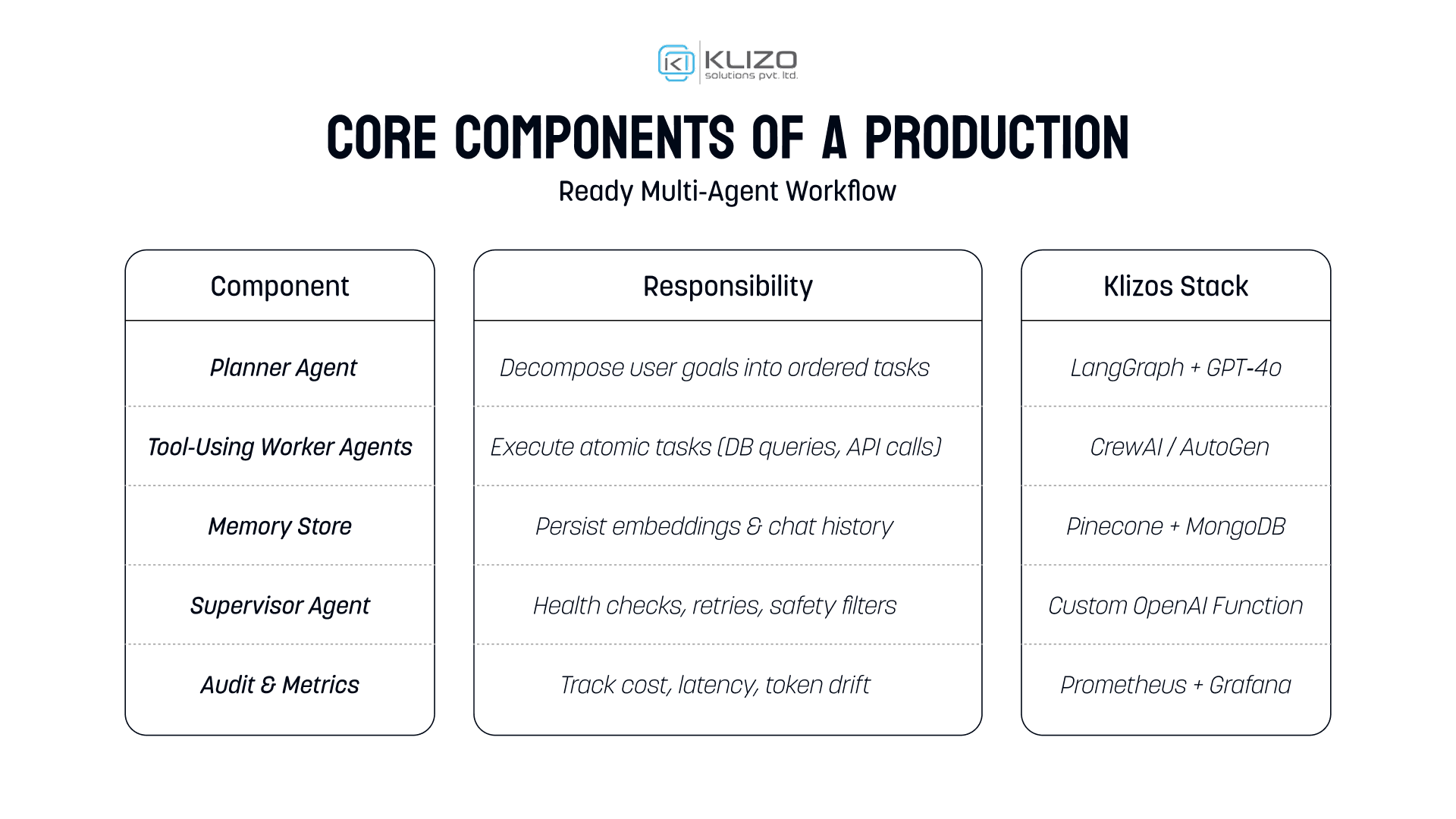
Architecture Patterns You Can Ship Today
1. Linear Pipeline (Fastest to Build)
Deterministic flows—részumé parsing → scoring → summary.
2. Blackboard / Shared Knowledge Base
Agents publish/subscribe to a vector “blackboard.” Best for research.
3. Event‑Driven Micro‑Agents
Loose coupling with Kafka or NATS; scales horizontally.
4. DAG Orchestration (Our Favorite)
Visualize dependencies, add retries, and gather rich metrics using LangGraph.
Pro‑tip: Keep DAG depth ≤ 8 layers or debug hell emerges.
Framework Showdown
| Feature | CrewAI | AutoGen | LangGraph | MetaGPT |
| Language | Python | Python | Python | Rust & JS |
| Visual Debugger | ❌ | Limited | ✅ | ❌ |
| Built‑in Memory | VectorStore | Redis | Any LangChain store | SQLite |
| Function Calling | ✅ | ✅ | ✅ | ✅ |
| Best For | Quick PoCs | Research bots | Production DAGs | Edge Agents |
Verdict: For enterprise‑grade Agentic AI in Production, LangGraph wins on observability and retries; pair with AutoGen for advanced function calling.
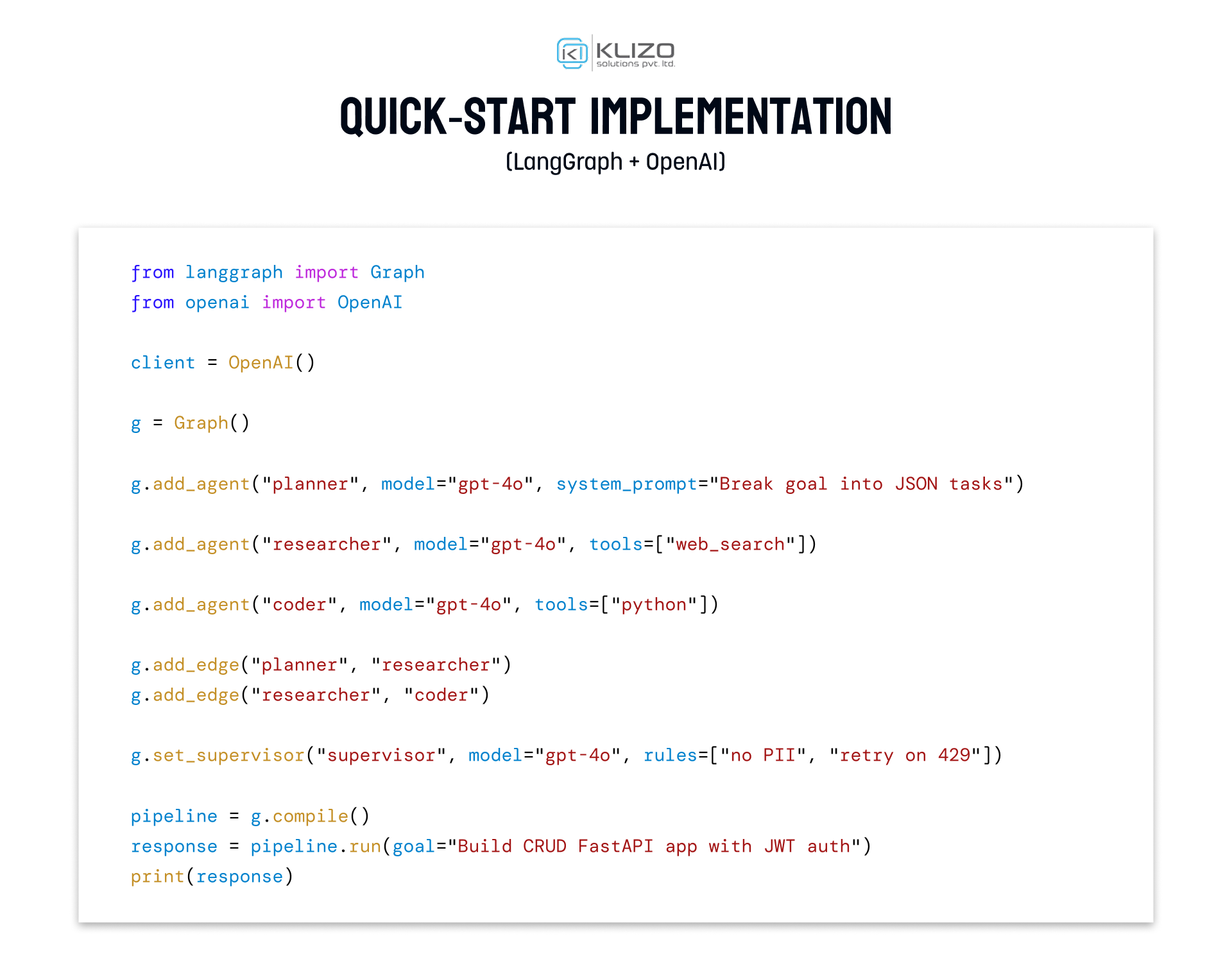
Deployment Blueprint
- GitHub Actions: Lint → unit tests → synthetic agent tests (AutoGen EvalSuite).
- Docker Build: Each agent containerized for isolation.
- Canary Release: Linear 5 % traffic shift via Argo Rollouts.
- Feature Flags: LaunchDarkly toggles new agents per user cohort.
- Observability Hook: Prometheus sidecar scrapes token & latency metrics.
Monitoring & Observability
| Metric | Why It Matters | Grafana Query |
tokens_per_successful_output |
Cost & efficiency KPI | sum(tokens)/sum(success) |
hallucination_rate |
Quality | Custom regex error rate |
retry_count |
Reliability | sum(supervisor_retries_total) |
latency_p95 |
UX | histogram_quantile(0.95, rate(agent_latency_bucket[5m])) |
Performance & Cost Hacks
- Dynamic Context Window: Inject top‑k vectors per agent, not per request.
- Policy‑Based Model Routing: GPT‑4o for reasoning, GPT‑3.5‑Turbo for mundane tasks.
- Edge Inference: Micro‑agents running on WebGPU lower infra bills by ~18 %.
- Prompt Compression: Use semantic hashing for repeated prompts.
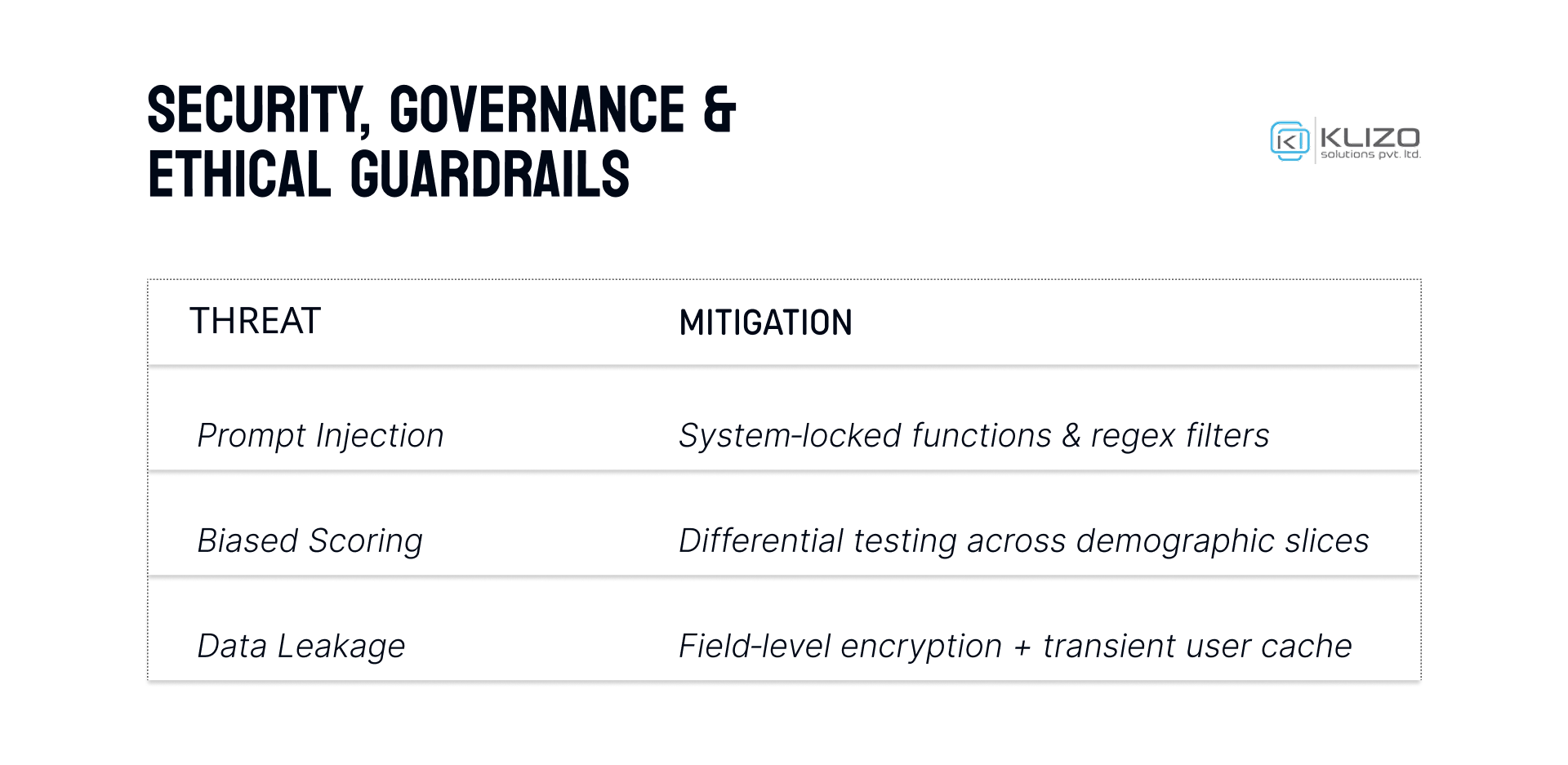
Testing & Evaluation
- Synthetic Task Suites: AutoGen’s
EvalSuiteruns 1000 scenarios overnight. - Human‑in‑the‑Loop: Observable dashboards surface anomalies for SMEs.
Future Trends to Watch
- Multimodal Agents that see & hear.
- Self‑Reflexive Agents capable of meta‑learning.
- Platform‑Native Agents deployed via Wasm in edge browsers.
Compliance Checklist
- ☑ GDPR Article 22 automated decision transparency
- ☑ EEOC hiring fairness documentation
- ☑ SOC 2 Type II evidence: agent logs + change controls
Migration Path: From Single Bot to Micro‑Agents
- Identify Independent Subtasks: e.g., retrieval, evaluation, summarization.
- Create Personas: Draft system prompts for each role.
- Externalize Memory: Move context to Pinecone.
- Add a Supervisor: Basic retry & safety rules.
- Incremental Rollout: Migrate 10 % of traffic; monitor KPIs.
Klizos Field Notes & War Stories
- Lesson #1: Short‑circuit loops early. During beta, a planner‑researcher loop generated 5000 tokens in 2 minutes. Guardrail:
max_turns=12. - Lesson #2: Observability is life. A silent 401 error on Pinecone killed retrieval; supervisor saved the day with fallback to local FAISS.
- Lesson #3: Human override wins trust. Expose “Review Draft” for QA agents—95 % of customers appreciate a final preview button.
FAQ
Q1: Do multi‑agent systems always cost more?
A1: Not if you route cheap models for rote tasks and cache aggressively.
Q2: Which vector DB is best for Agentic AI in Production?
A2: We like Pinecone for managed SLAs, but Weaviate Cloud is solid if you need hybrid search.
Q3: How do I debug agent loops?
A3: Enable step‑level logging in LangGraph and set a max_turns guardrail.
Glossary
- Agentic AI: System of autonomous, goal‑oriented agents collaborating to achieve outcomes.
- Supervisor Agent: Meta‑agent monitoring others for safety & retries.
- DAG: Directed Acyclic Graph—task dependency graph.
- FinOps: Cloud financial management discipline.
- SHAP: Explainability method (SHapley Additive exPlanations).
Conclusion
Agentic AI in Production turns isolated LLM calls into reliable, audit‑ready SaaS pipelines. Start small—one planner and two workers—then scale horizontally as metrics justify. Ready to build? Book a free strategy session with Klizos and ship multi‑agent magic in weeks, not months.


