By Joey Ricard - March 27, 2026
E-commerce is no longer about putting products on a website and hoping people buy them. That era ended years ago.
In 2026, the online stores that win are the ones that think. They predict what customers want before they search for it. They adjust prices in real time based on demand. They detect fraud in milliseconds. They have conversations with shoppers at 2 AM without a single human agent being awake.
The engine behind all of this is artificial intelligence.
The AI-powered e-commerce market, valued at $8.65 billion in 2025, is projected to reach $22.60 billion by 2032. Over half of US consumers say they have already used ChatGPT or Gemini to browse and buy online. And 95% of e-commerce brands using AI technology are seeing a strong return on their investment.
The question is no longer whether your online store needs AI. The question is which AI features you need to build first.
At Klizo Solutions, we have been building custom e-commerce platforms, web applications, and SaaS products for businesses across industries. We have developed robust custom e-commerce platforms with specialized secure payment gateways, AI-powered email engines, and advanced integrations. This article walks you through every AI feature a smart e-commerce platform should have in 2026, why each one matters, and how to implement them effectively.
Direct Answer: A smart e-commerce platform uses artificial intelligence to automate operations, personalize customer experiences, optimize pricing, predict demand, and secure transactions – all in real time, with minimal human intervention.
A traditional e-commerce platform is static. It shows the same homepage to every visitor. It charges the same price regardless of demand. It relies on human agents for customer support. It reacts to inventory problems after they happen.
A smart e-commerce platform is dynamic. It adapts to every individual visitor. It adjusts pricing based on dozens of real-time signals. It resolves customer queries automatically. It predicts inventory needs before shortages occur.
The difference between these two approaches is not incremental. According to Salesforce, AI-powered e-commerce tools can lead to more than a 25% improvement in customer satisfaction, revenue, or operational cost reduction. Stores using AI-driven personalization report higher conversion rates, increased average order values, and significantly stronger customer retention.
The core AI technologies that power smart e-commerce platforms include:
Now let us walk through the specific AI features every online store should have.
Direct Answer: AI product recommendations analyze browsing history, purchase patterns, and behavioral signals to show each customer the products they are most likely to buy – increasing conversion rates and average order value.
Personalization is the single most impactful AI feature for e-commerce. When a customer visits your store, the homepage they see, the products highlighted, and the offers displayed should all be tailored to their specific behavior and preferences.
This is not about adding someone’s first name to an email. Modern AI personalization engines analyze hundreds of data points – past purchases, browsing patterns, time of day, device type, location, and even similarities to other customer segments – to deliver hyper-relevant product suggestions in real time.
The numbers back this up. Insider One reports that 71% of e-commerce sites now offer AI-powered product recommendations, with that number jumping to 90% in Nordic countries. Businesses using AI-driven personalization see up to a 30% improvement in customer retention.
How to implement it:
At Klizo Solutions, we build custom e-commerce platforms with recommendation engines tailored to your specific product catalog and customer base. Our web application development team integrates these systems directly into your platform architecture, ensuring they scale as your business grows.
Direct Answer: AI chatbots handle up to 93% of customer queries without human intervention, providing 24/7 support, reducing costs by 30-70%, and resolving complaints 90% faster.
Customer service is one of the biggest operational costs for e-commerce businesses. It is also one of the biggest sources of customer frustration when done poorly. AI chatbots solve both problems simultaneously.
Modern AI chatbots are not the frustrating rule-based bots from five years ago. Today’s conversational AI assistants understand context, remember previous interactions, handle complex multi-step queries, and can even detect customer sentiment to adjust their tone accordingly.
According to Unified AI Hub, companies implementing AI customer service see 90% faster complaint resolution, 80% automation of routine support tasks, and support cost reductions of 30-70%. DHL research shows that 7 in 10 shoppers actively want retailers to offer AI-powered features when shopping.
Key capabilities your AI chatbot should have:
How to implement it:
At Klizo, we have built chatbots, Facebook applications, and conversational AI tools for clients across industries. Our teams have integrated some of the most advanced technologies into web and mobile applications, and we can help you build a chatbot that actually resolves problems rather than creating new ones.
Direct Answer: Visual search lets customers upload a photo to find matching or similar products instantly, increasing engagement by 30% compared to traditional text search.
Imagine a customer sees a pair of shoes on Instagram. They screenshot it, open your store, upload the image, and instantly find the exact product or similar alternatives in your catalog. That is visual search.
This feature is powered by computer vision and deep learning models that analyze images, identify objects, colors, patterns, and styles, and match them against your product database. Insider One reports that retailers deploying visual search see a 30% higher engagement rate versus traditional text searches.
Visual search is particularly powerful for fashion, home décor, furniture, and any visually-driven product category. It shortens the path from inspiration to purchase dramatically.
How to implement it:
At Klizo Solutions, our teams have experience with facial recognition, image processing, and advanced computer vision integrations. We can build visual search capabilities directly into your mobile application or web platform.
Direct Answer: Dynamic pricing uses AI to automatically adjust product prices based on demand, competition, inventory levels, and customer behavior – maximizing revenue and margins in real time.
Static pricing leaves money on the table. When demand spikes, you miss margin opportunities. When demand drops, you sit on unsold inventory. AI-driven dynamic pricing solves this by continuously optimizing prices based on real-time signals.
According to BigCommerce, AI-enabled dynamic pricing calculates the minimum discount necessary for a sale, predicts when and what to discount, and adjusts prices based on supply, demand, competitor pricing, and customer segments.
Factors AI considers for dynamic pricing:
How to implement it:
This is not price gouging. When implemented correctly, dynamic pricing benefits both the business and the customer by ensuring competitive prices during high-competition periods and protecting margins during high-demand periods.
Direct Answer: AI-powered search understands what customers mean, not just what they type – delivering relevant results for natural language queries like “comfortable running shoes for flat feet” instead of requiring exact keyword matches.
Traditional e-commerce search is keyword-based. If a customer types “blue dress” they get results matching those exact words. If they type “something elegant for a summer wedding” they get nothing useful.
AI-powered search uses natural language processing to understand intent, context, and semantics. It handles synonyms, misspellings, conversational queries, and even ambiguous requests. It learns from user behavior to improve results over time.
Constructor, a leading AI-powered e-commerce search platform, reports that intelligent search directly impacts conversion rates and average order values by surfacing the most relevant products based on behavioral data and business KPIs.
Key features of AI-powered e-commerce search:
How to implement it:
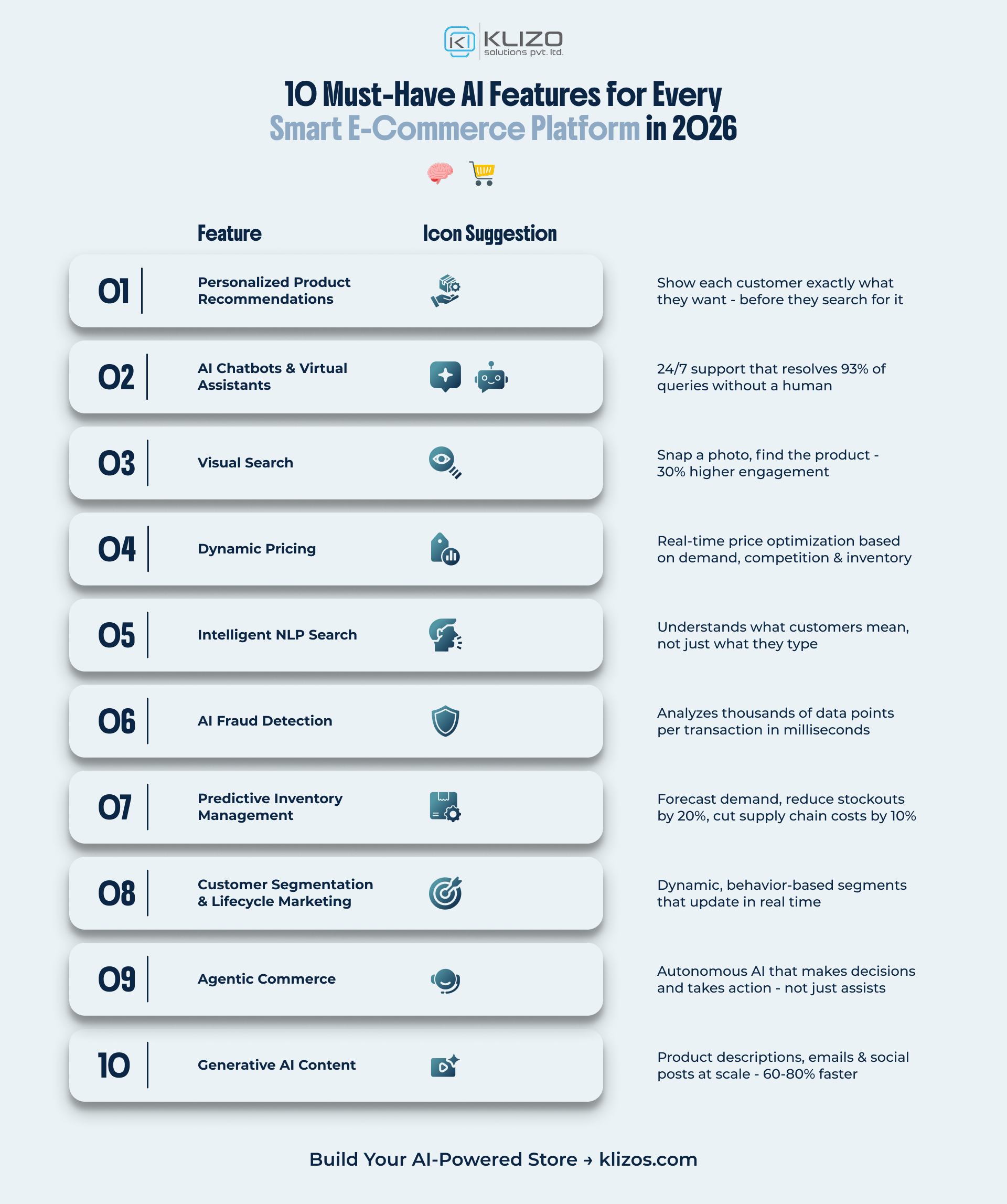
Direct Answer: AI fraud detection analyzes thousands of data points per transaction in milliseconds, identifying suspicious patterns that would be impossible for humans to catch – reducing chargebacks while minimizing false positives that block legitimate customers.
E-commerce fraud is a growing problem. As online transactions increase, so do sophisticated fraud attempts. AI-powered fraud detection systems analyze transaction patterns, device fingerprints, behavioral biometrics, and historical data to flag suspicious activity in real time.
According to the E-Commerce Times, AI agents are forcing e-commerce firms to reassess their fraud detection strategies. Companies that fail to adopt AI-powered fraud infrastructure will face either declining conversions from false positives or increased losses from undetected fraud.
Key AI fraud detection capabilities:
At Klizo Solutions, we have built specialized secure payment gateways and compliance-driven platforms. Our work in the cannabis industry required building technology that complies with strict legal requirements for ID and age verification during payment – the same security-first approach we bring to every e-commerce platform we build.
Direct Answer: AI demand forecasting combines historical data, market trends, seasonal patterns, and real-time signals to predict what products to stock, when, and how much – reducing stockouts by up to 20% and lowering supply chain costs by 10%.
Out-of-stock products lose sales. Overstocked products tie up capital and lead to heavy discounting. Getting inventory right has always been one of retail’s biggest challenges, and AI finally makes accurate demand forecasting accessible.
According to Unified AI Hub, companies using AI in supply chain planning see revenues up to 4% higher, inventory 20% lower, and supply chain costs 10% lower. The AI in supply chain market was valued at $11.73 billion in 2025 and is expected to reach $40.53 billion by 2030.
What AI demand forecasting considers:
How to implement it:
Direct Answer: AI customer segmentation goes beyond basic demographics to create dynamic segments based on behavior, purchase patterns, predicted lifetime value, and churn risk – enabling hyper-targeted marketing that converts.
Traditional customer segmentation groups people by age, location, or gender. AI segmentation creates dynamic, behavior-based segments that update in real time. It identifies high-value customers, predicts who is about to churn, and determines the optimal message, channel, and timing for each segment.
Salesforce reports that AI-powered customer segmentation continuously updates based on real-time data, ensuring marketing stays relevant without constant manual oversight.
AI segmentation capabilities:
At Klizo Solutions, our digital marketing team combines data-driven segmentation with targeted campaigns. We help build marketing strategies, lower monthly ad spends, and create content that converts – all powered by the data your platform collects.
Direct Answer: Agentic commerce is the next evolution of AI in e-commerce – autonomous AI agents that make decisions, take actions, and optimize operations in real time with minimal human input.
This is the most significant shift happening in e-commerce AI right now. Unlike traditional automation that follows preset rules (if this, then that), agentic AI makes decisions based on real-time data and learns from outcomes.
According to BigCommerce, by 2028, one in three enterprise software platforms will include agentic AI capabilities. The E-Commerce Times reports that unified platforms and agentic AI will define e-commerce in 2026, changing how retailers manage operations, fulfillment, and costs.
What agentic AI can do for your e-commerce platform:
As we discussed in our article on AI Agents Are Becoming Operating Systems, agentic AI has evolved from simple task automation to systems that perceive, reason, and act with increasing independence. For e-commerce, this means your platform can become a self-optimizing system that gets smarter every day.
Direct Answer: Generative AI creates product descriptions, marketing copy, email campaigns, social media content, and even product images – reducing content production time by 60-80% while maintaining brand consistency.
Writing unique product descriptions for thousands of SKUs is a massive operational burden. Generative AI solves this by producing high-quality, SEO-optimized content at scale.
According to Unified AI Hub, retailers could see $240 billion to $390 billion in additional annual value from generative AI. Tools can now write product descriptions in your brand voice, create A/B test variants, translate content into multiple languages, and draft social media posts that sound authentic.
Generative AI use cases for e-commerce:
At Klizo Solutions, our copywriting and social media marketing teams leverage AI tools to create consistent, high-quality content at scale. We combine AI efficiency with human creativity and strategic oversight to ensure every piece of content serves your business goals.
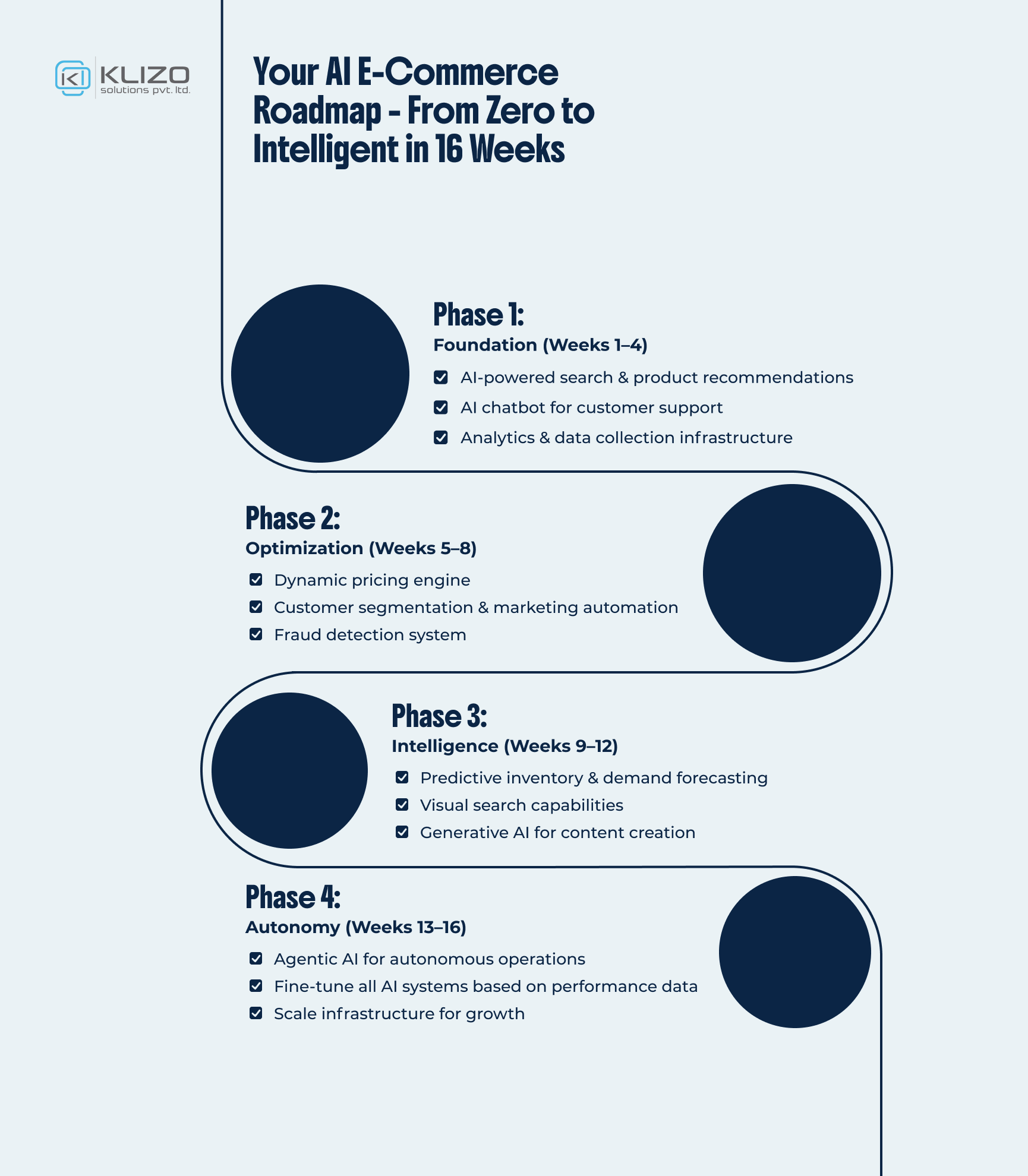
Building a smart e-commerce platform does not mean implementing all ten features at once. It means starting with the features that address your biggest pain points and scaling from there.
Phase 1: Foundation (Weeks 1-4)
Phase 2: Optimization (Weeks 5-8)
Phase 3: Intelligence (Weeks 9-12)
Phase 4: Autonomy (Weeks 13-16)
As we outlined in our guide on How to Build an MVP in 2026, the key principle is to start lean, validate with real users, and iterate based on data. The same approach applies to AI feature implementation.
At Klizo Solutions, we do not just add AI features to existing templates. We build custom e-commerce platforms from the ground up with AI integrated into the architecture.
What makes working with Klizo different:
Whether you are building a new e-commerce platform from scratch or upgrading an existing store with AI capabilities, talk to our team. We will help you identify the right AI features for your business, estimate the complexity and costs, and build a platform that sells smarter.
The e-commerce platforms that will dominate in 2026 and beyond are not the ones with the most products or the biggest ad budgets. They are the ones that use AI to understand their customers deeply, operate efficiently, and adapt in real time.
Every feature we covered in this article – from personalized recommendations and AI chatbots to dynamic pricing, visual search, fraud detection, predictive inventory, customer segmentation, agentic commerce, and generative AI – represents a competitive advantage that compounds over time. The AI systems learn, improve, and optimize continuously. The longer you wait to implement them, the further behind you fall.
As we discussed in our article on Answer Engine Optimization, the market in 2026 rewards substance over hype. Building a smart e-commerce platform is not about chasing trends. It is about building a technology foundation that makes your business fundamentally better at serving customers and generating revenue.
The online stores that win in 2026 are not just selling products. They are building intelligent systems that sell smarter every single day.
What is an AI-powered e-commerce platform?
An AI-powered e-commerce platform is an online store that uses artificial intelligence technologies – including machine learning, natural language processing, computer vision, and predictive analytics – to automate operations, personalize customer experiences, optimize pricing, forecast demand, and secure transactions in real time.
What are the most important AI features for an online store in 2026?
The most impactful AI features are personalized product recommendations, AI chatbots for customer support, intelligent search with NLP, dynamic pricing, visual search, fraud detection, predictive inventory management, customer segmentation, agentic commerce capabilities, and generative AI for content creation.
How much does it cost to build an AI-powered e-commerce platform?
Costs vary based on complexity. A basic e-commerce platform with core AI features (recommendations, chatbot, smart search) can range from $30,000 to $80,000. A full-featured platform with dynamic pricing, visual search, fraud detection, and agentic capabilities can range from $100,000 to $300,000 or more. Working with an experienced development partner like Klizo Solutions can significantly reduce costs while ensuring quality.
Can I add AI features to my existing e-commerce store?
Yes. Most AI features can be integrated into existing platforms through APIs and microservices architecture. You do not need to rebuild your entire store. Start with high-impact features like product recommendations and chatbots, then progressively add more advanced capabilities.
What is agentic commerce and why does it matter?
Agentic commerce refers to AI systems that autonomously make decisions and take actions in your e-commerce operations – such as adjusting prices, reordering inventory, launching promotions, and optimizing checkout flows – with minimal human input. By 2028, one in three enterprise software platforms will include agentic AI capabilities, making it a critical competitive advantage.
How does AI improve e-commerce conversion rates?
AI improves conversion through personalized product recommendations, intelligent search that understands customer intent, dynamic pricing that offers competitive prices, chatbots that resolve purchase hesitations instantly, and optimized checkout flows that reduce cart abandonment. Combined, these features can increase conversion rates by 15-30%.
Is AI in e-commerce only for large businesses?
No. AI tools have become significantly more accessible and affordable. Cloud-based AI APIs (OpenAI, Google Cloud AI, AWS) offer pay-per-use pricing that makes AI features viable for businesses of all sizes. Even small e-commerce stores can implement AI chatbots, product recommendations, and smart search without enterprise-level budgets.
How does AI help with e-commerce SEO and content?
Generative AI creates SEO-optimized product descriptions, blog content, email campaigns, and social media posts at scale. AI also powers Answer Engine Optimization (AEO), ensuring your product data and content are structured for AI-powered search engines like ChatGPT, Gemini, and Perplexity – which are increasingly how consumers discover and buy products.

Joey Ricard
Klizo Solutions was founded by Joseph Ricard, a serial entrepreneur from America who has spent over ten years working in India, developing innovative tech solutions, building good teams, and admirable processes. And today, he has a team of over 50 super-talented people with him and various high-level technologies developed in multiple frameworks to his credit.



Klizo Solutions Pvt. Ltd. is a specialized development company. Let us build your solution.