By Joey Ricard - May 6, 2026
Your business is ready for custom software in 2026 when off-the-shelf tools start costing you more in workarounds than they save in subscriptions. The seven clearest signs are: manual workflows eating your team’s time, disconnected tools, scaling pain, rising SaaS costs, reporting delays, weak security or compliance, and a real need for features that simply don’t exist in any product on the market
We see it every week at Klizo. A founder books a call and says, “We’ve been managing this on Excel for two years. It’s getting messy.”
It was messy 18 months ago. They just didn’t want to deal with it.
Here’s the truth in 2026: SaaS tools are great until they aren’t. The moment your team starts inventing workarounds, copy-pasting between five tabs, or hiring people just to manage the chaos, you’ve already outgrown your stack. You’re just paying for the lag.
Custom software isn’t about being fancy. It’s about removing friction. And friction is what’s quietly killing your margins right now.
This article gives you the 7 honest signs you’re ready, mapped to real solutions our team has actually built.
If your operations run on Google Sheets and Excel – attendance, leads, inventory, project tracking, payroll – that’s not a system. That’s hope.
Spreadsheets break down the moment you cross 10 people. Version conflicts, no audit trail, broken formulas, zero automation, and a single intern can wipe out a quarter of data with one wrong paste.
You’re ready for custom software when: your business decisions depend on data
that lives in a spreadsheet someone updated “this morning, I think.”

Resume screening. Status updates. Pulling reports. Copying leads from one CRM to another. Manually filtering candidates. Chasing employees for timesheets.
If a human is doing it daily and the output is predictable, software should be doing it.
In 2026, this is no longer a “nice-to-have.” Your competitors already automated round one. According to LowCode Agency, the most reliable readiness signal is integration debt – manual data movement that compounds with headcount.
You’re ready when: you can name three tasks that someone on your team does every day that a script could handle in seconds.

Marketing in HubSpot. Sales in Pipedrive. Finance in QuickBooks. Project tracking in Trello. HR in BambooHR. Customer support in Freshdesk.
Six tools, zero communication. Your team is the integration layer – and they’re exhausted.
This is the most expensive problem in modern business and almost nobody puts a number on it. As Fingent’s analysis points out, poor integration = double data entry, inconsistent information, and delayed operations.
You’re ready when: someone in your office is paid full-time to “move things between systems.”
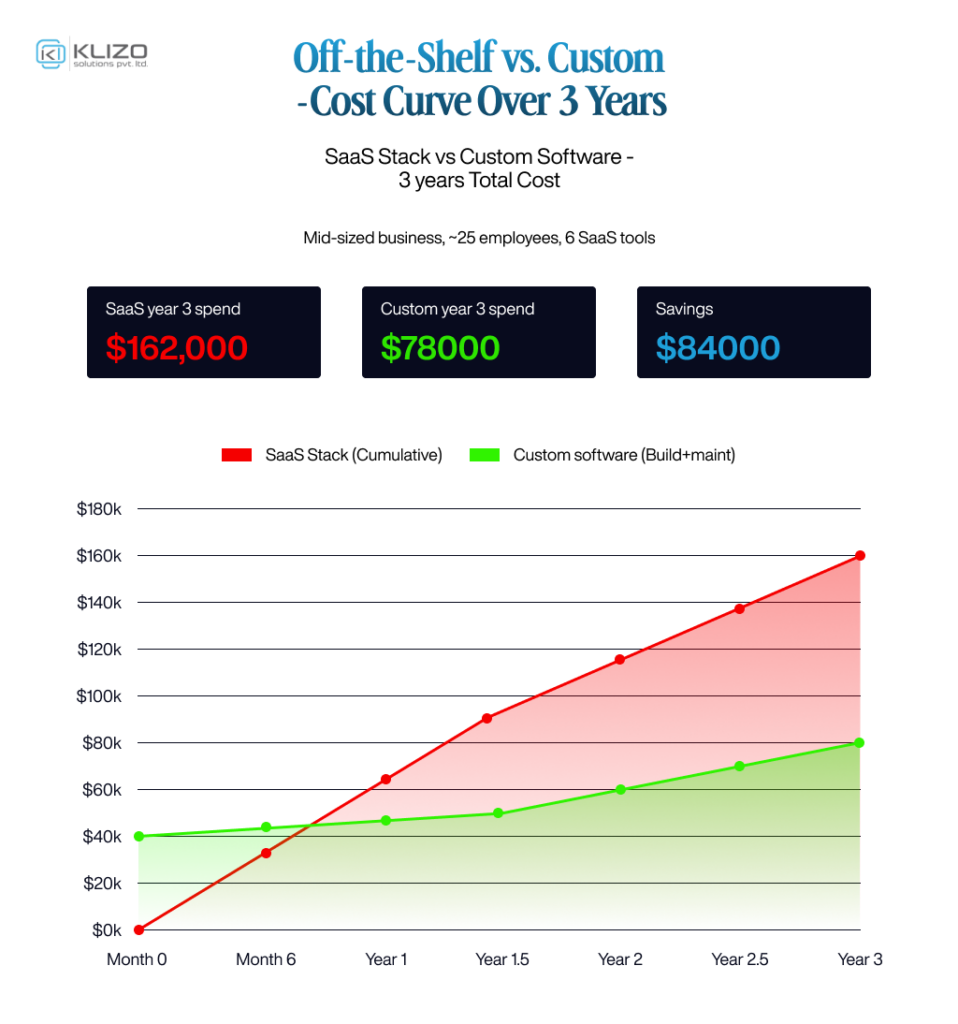
Pull your last 12 months of subscription invoices. Most businesses we audit are spending 3000-15,000/month on SaaS tools they barely use 30% of.
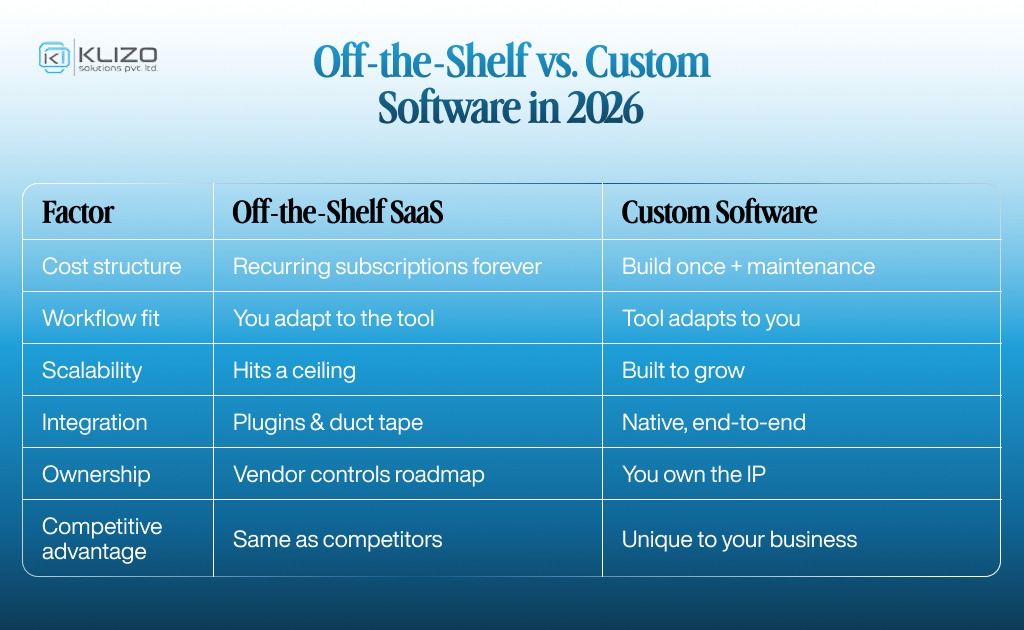
Custom software flips the math. You pay once to build, then pay maintenance – usually a fraction of the stacked subscription costs over 3 years.
You’re ready when: your annual SaaS spend exceeds what a tailored build would cost amortized over 3 years. Most of the time, it does.
If your weekly leadership meeting waits on someone manually pulling numbers from three platforms into a deck, your reporting infrastructure is broken.
In 2026, leadership decisions need real-time dashboards, not Tuesday-morning Excel exports. As
Odyssey notes, modern systems are expected to be intelligent – not just functional.
You’re ready when: the answer to “how did we do last week?” takes more than 30
seconds to answer.

Healthcare? Finance? Legal? Real estate? Public companies?
Off-the-shelf software is built for the average. The average doesn’t have your compliance officer, your audit trail requirement, or your industry-specific workflow.
We’ve built compliance-heavy systems for real estate, and now public-company investor relations. Generic tools simply do not bend that far without breaking.
You’re ready when: “we just need to customize one more thing” is something your team says every week.

This is the cleanest signal of all. You’ve Googled it. You’ve demoed five tools. You’ve talked to vendors. Nothing fits.
That’s not a SaaS gap. That’s a custom software opportunity – and usually a competitive moat.
If your operational process is the thing that makes you different from competitors, building it on the same SaaS your competitors use means giving away your edge.
You’re ready when: the workflow that defines your business cannot be bought off
the shelf.

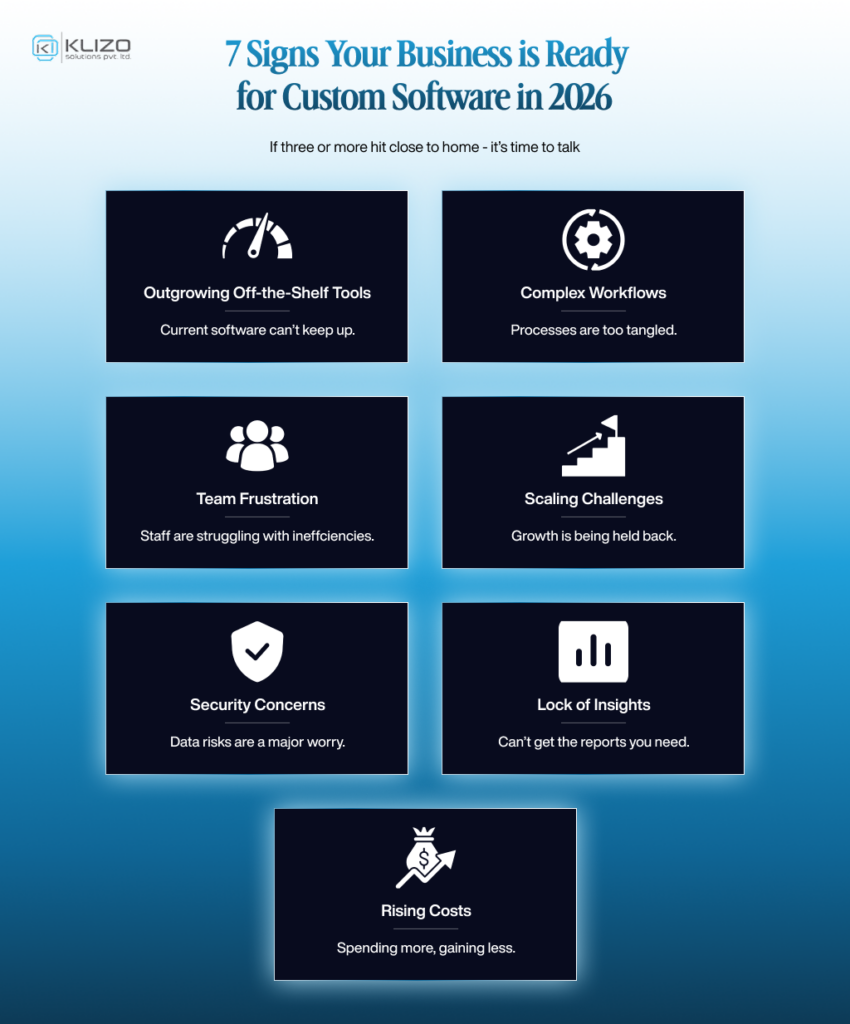
If three or more of these signs hit close to home, the question isn’t if you should invest in custom software. It’s how much longer can you afford not to?
At Klizo Solutions, we’ve spent 10+ years building exactly this kind of software for SMBs and scale-ups across the US, India, and beyond. From AI-powered hiring tools and attendance systems to investor relations platforms and full SaaS marketplaces – we build technology that fits your business, not the other way around.
We’re not here to sell you software. We’re here to figure out if you actually need it. And if you do, build it right the first time.
👉Talk to a Klizo client manager – we’ll map your workflow, run the build-vs-buy math with you, and tell you honestly whether a custom build makes sense.
Ans: If your team relies heavily on spreadsheets, manual tasks, or 5+ disconnected SaaS tools, and reporting takes days instead of minutes, you need custom software. Three or more of the seven signs above is a strong readiness signal.
Ans: Yes. In 2026, custom software is more accessible than ever thanks to modern frameworks and AI-assisted development. Most SMBs see positive ROI within 12–24 months, primarily through eliminating SaaS subscriptions and recovered employee hours.
Ans: Internal tools typically range from $25,000 to $8, 000 to 50,000. Full SaaS products range from 250,000+. Klizo offers on-demand mobile apps starting at $3,000.
Ans: Simple internal tools: 6–10 weeks. Mid-complexity systems: 3–6 months. Full SaaS platforms: 6–12 months.
A: Yes, that’s usually the strongest reason to build custom in the first place. Custom software typically becomes the central integration layer connecting CRM, ERP, HRMS, accounting, and analytics platforms.
Ans: Healthcare, fintech, real estate, e-commerce, cannabis, manufacturing, logistics, and any industry with unique compliance or workflow needs that generic SaaS cannot handle.
Previous article
The Developer’s Guide to Vector Databases in 2026: Beyond the Hype

Joey Ricard
Klizo Solutions was founded by Joseph Ricard, a serial entrepreneur from America who has spent over ten years working in India, developing innovative tech solutions, building good teams, and admirable processes. And today, he has a team of over 50 super-talented people with him and various high-level technologies developed in multiple frameworks to his credit.

Klizo Solutions Pvt. Ltd. is a specialized development company. Let us build your solution.